




1 min read
Research suggests this is how to build a high performing team
In a recent Fast company article, Dr. Tomas Chamorro-Premuzic made the bold statement that an under-rated leadership skill is being able to build a...

Develop leaders, strengthen executive teams and gain deep insights with assessments designed to accelerate trust and performance.

Transform how your leaders think and perform with keynotes that spark connection, trust and high-performance cultures.

Explore practical tools, thought-leadership and resources to help you build trusted, high-performing teams.

Trustologie® is a leadership development consultancy founded by Marie-Claire Ross, specialising in helping executives and managers build high-trust, high-performing teams.

4 min read
Trust in business is foundational. It underlies every human relationship, every interaction, every communication, every initiative, every work project, and any strategic goal you aim to achieve.
Without trust, there is no meaningful connection between a group of people. It’s just meaningless coordination. It’s trust that shifts a group of people into a team.
As a leader, you have an opportunity to build trust in every minute of the day.
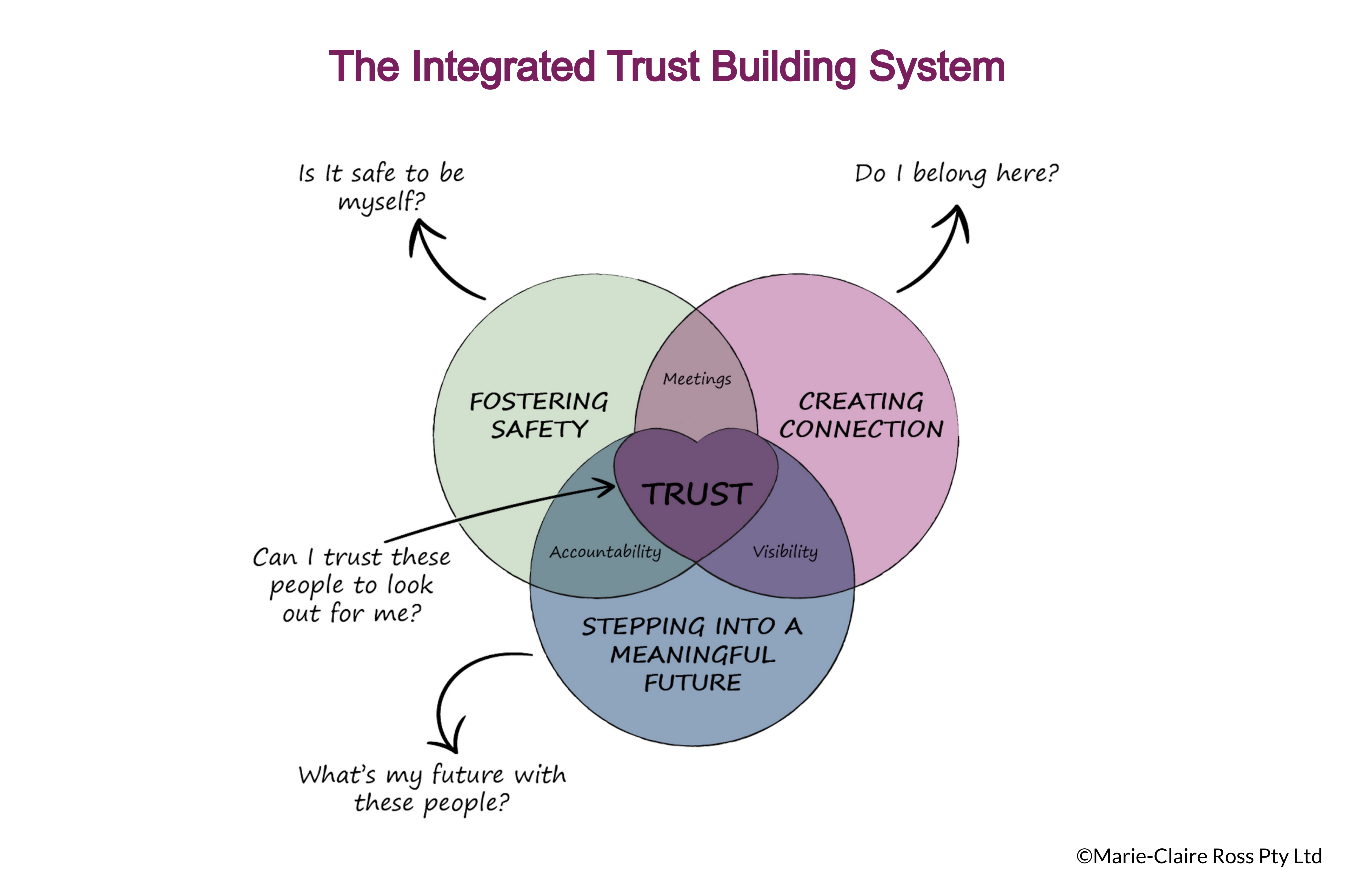
In the Integrated Trust Building System, leaders emotionally engage employees using three communication practices critical for high performance according to neuroscience: safety, connection and a meaningful future. Then, there are three corresponding actions where leaders practise these communication techniques: in meetings/one-on-ones, visibility and accountability).
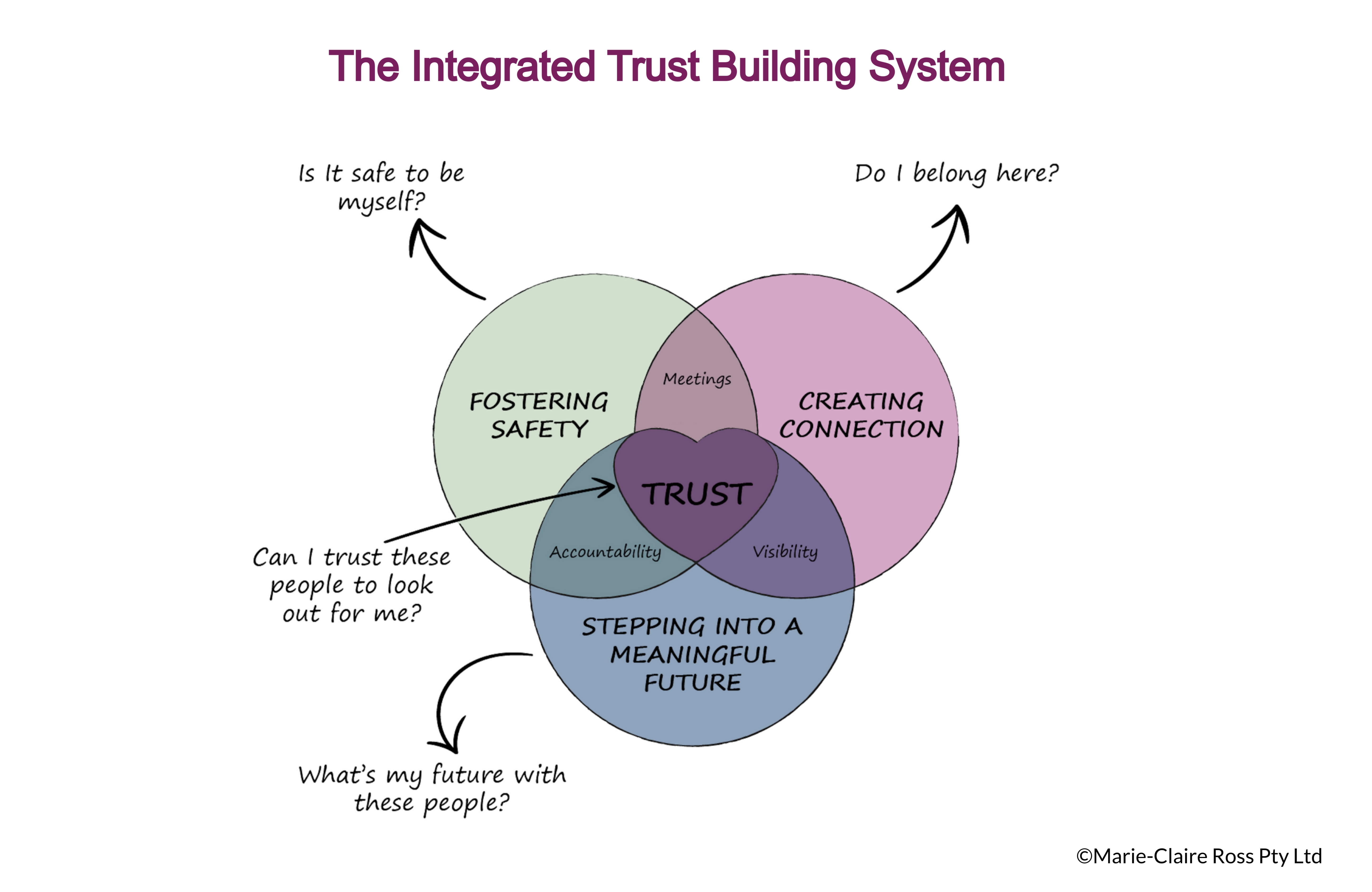
(The Integrated Trust Building System is taken from the book, Trusted to Thrive, get a free chapter here)
Essentially, employees want to see evidence that the organisation and leaders care about people. And they need to feel it through observing how leaders interact and treat people.
Let's go through the interactions when leaders are communicating whether they can be trusted either verbally or non-verbally.
The absence of these regular touch points not only leads to reduced trust but misalignment with your employees. It is one of the most time efficient ways to build trust with employees and improve their performance.
According to a recent Humu survey involving 350 managers and individual contributors, employees who participated in weekly one-on-one meetings experienced 20% less anxiety, dreaded the meetings 17% less, and felt 12% more successful in their roles than those who met with their managers less frequently.
The best one-on-ones are customised to the needs of your report. They are structured to ensure that the employee asks the majority of questions, so they have inspiring career development conversations and support. It's one of the proven ways to build trust.
Meetings build trust, not only with each direct report, but with your team members.
Frequently, I see leaders unintentionally decrease trust by not greeting people, avoiding eye contact, talking to the most opinionated person, or shutting down people who challenge an item.
People will be more likely to trust you if you make meetings a safe space - where team members treat each other respectfully, when you admit you made a mistake, when you lead by asking questions and don't talk for most of the meeting. I see many people "who love to talk" hold meetings where people are bored and who have little opportunity to contribute. Respecting people's time, not overly pushing your individual agenda and running an efficient meeting builds trust.
High trust leaders also expect accountability in the meeting - people are held to what they promised in the last meeting, goals and progress made is shared, recognition is provided and future actions are recorded and dispersed.
It seems counter-intuitive, but how you do, or don't do, a difficult conversation, impacts whether people will trust you.
If you don't do them, when someone has under-performed or behaved inappropriately, you send the message that it's okay to not do work to a high standard or treat people badly. High performers will then wonder why they work so hard, when poor performance is ignored.
If you do a difficult conversation, but you don't let the other person share their perspective, you blame them or avoid eye contact with them, they will be less likely to trust your leadership. Being confident when you do a difficult conversation and coming from the perspective that you are there to help the other person grow their potential, will actually build trust.
According to a Zenger and Folkman study, 72% of people when asked what was most helpful in their career, said they thought their performance would improve if their managers would provide corrective feedback. Yet, only 5% of people believe their managers provide such feedback. Learning to do a difficult conversation well, actually builds trust and respect.
This is for those of you who work in the office - people are watching and assessing all of your leadership behaviours. Do you greet people in a friendly manner? Do you have a friendly demeanour in general or do you grumble and complain? Do you speak negatively about colleagues?
How you show up works towards how people will trust you. Make sure you use positive language and help people feel good about themselves and their day.
Avoid saying anything negative about people you work with. As a leader, it makes people feel very uncomfortable if they see you gossip because they will be wondering what you are saying behind their back. It also gives your reports permission to do the same.
Leaders often don't delegate enough because they are worried the person won't do a good job or because they fear overwhelming people by putting too much on their plate.
Either way, this can have a damaging effect on your team who will feel that you don't trust them to get work done, leading to decreased morale, engagement and low team capabilities.
Smart delegation, using a clear structured approach actually builds trust, not detracts from it. It requires thinking through clearly the work to be done, your expectations, who is ready to learn (and if you have time to adequately mentor), how the work will be measured and when check-ins will happen.
When you use the right process to delegate it also establishes clear boundaries that will increase the productivity of your team (According to a study, productivity is estimated to be a high 59% when boundaries are established, while also enhancing team satisfaction by 51%).
For some of us, revealing how we are feeling is uncomfortable. Depending on our cultural background or leadership role models, we might lead with a poker face.
As I'm finding more regularly with my students (particularly those from a UK background) is that revealing their feelings and letting down their guard, actually rewards them more as a leader than they ever thought previously.
When we can be honest that we are feeling worried or that we don't know what will happen, it fosters deeper connections and engenders trust with our teams. People want to know that you're a human - not a robot that hides their feelings.
Recent research has found that leaders who embraced vulnerability witnessed a 66% increase in team trust levels and a 49% rise in team cohesion.
Trust is the cornerstone of effective leadership and team dynamics. By consistently applying the principles of the Integrated Trust Building System, leaders can create a culture of safety, connection, and accountability. As you cultivate these practices, remember that trust takes time to build but can be easily lost; therefore, your ongoing commitment to fostering trust will not only enhance employee engagement but also drive organisational success. Embrace this journey, and watch your team thrive.
If you want to learn how to do these interactions more effectively, then join the Tribe of Trusted Leaders - Leadership Development program. Enrolment is now open for a March 2026 start.

1 min read
In a recent Fast company article, Dr. Tomas Chamorro-Premuzic made the bold statement that an under-rated leadership skill is being able to build a...
1 min read
High-performance teams are vital to an organisation’s success. But they need TRUST first to succeed.
1 min read
So you've just been elevated to the position of leading a brand new team - congratulations! No matter if this is your first time or you're a seasoned...