



Why Great Workplace Safety Professionals are Artists
The best safety professionals that I've worked with like safety. They read all the right safety magazines and go to all the right safety...

Develop leaders, strengthen executive teams and gain deep insights with assessments designed to accelerate trust and performance.

Transform how your leaders think and perform with keynotes that spark connection, trust and high-performance cultures.

Explore practical tools, thought-leadership and resources to help you build trusted, high-performing teams.

Trustologie® is a leadership development consultancy founded by Marie-Claire Ross, specialising in helping executives and managers build high-trust, high-performing teams.

4 min read
Implementing change in the workplace often creates pressure, uncertainty, and emotional reactions - especially during a workplace crisis.
Successful leaders don’t avoid this stress. They transform it.
When pressure hits, most leaders react automatically from fear in ways that unintentionally shut down thinking, reduce trust, and escalate problems. The best leaders do something different. They pause, reframe what’s happening, and activate responses that help their teams stay grounded, think clearly, and move forward together.
This difference in response is what separates leaders who just survive workplace change from those who lead others through it with confidence and capability.
How do you react when you feel attacked, criticised, or receive bad news?
For many leaders, these moments trigger fast, defensive responses. Words come out sharper than intended. Control tightens. People feel blamed, reassured too quickly, or shut down altogether. What started as a challenge turns into unnecessary drama.
Yet there is a better way.
As an executive coach, I work with leaders on how to respond when change feels threatening - not by suppressing emotion, but by regulating it. What I consistently see is this: high-performing leaders don’t react less. They react differently.
They are calmer, more composed, and more intentional in how they respond when it matters most.
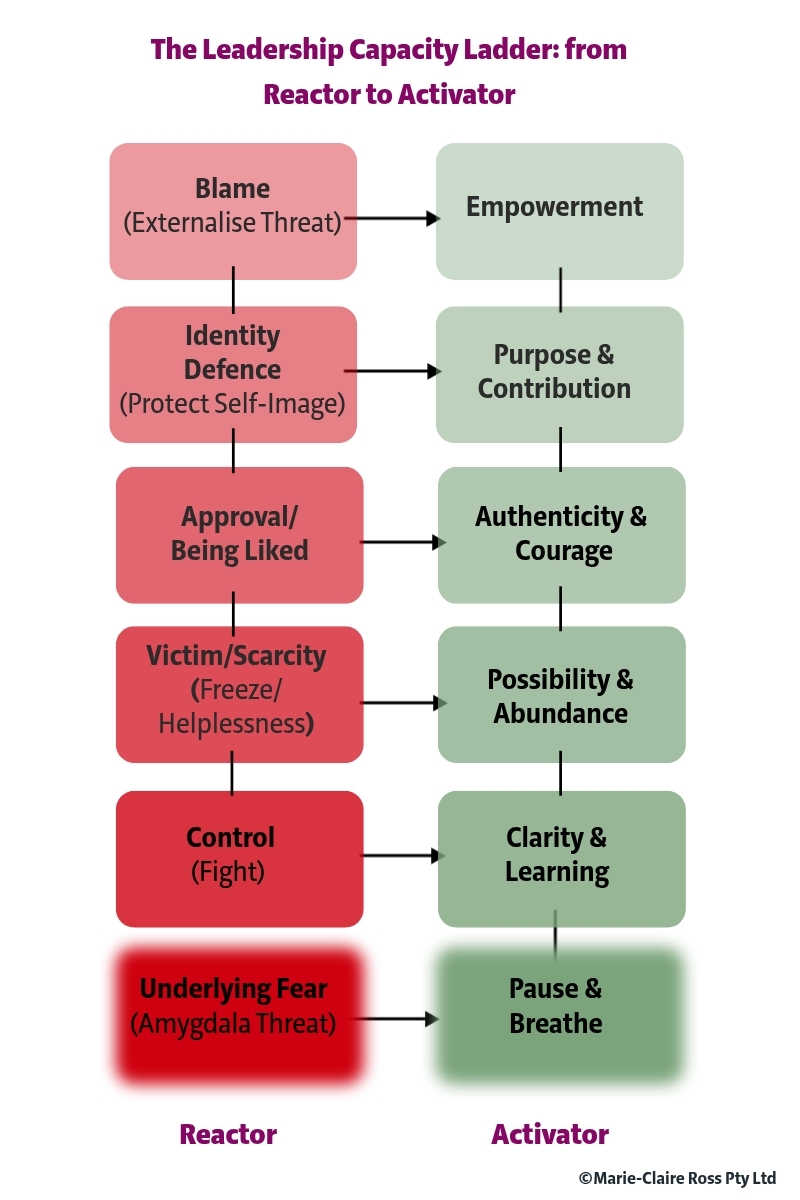
To explain this, I use what I call The Leadership Capacity Ladder: From Reactor to Activator.
When bad news hits - a missed deadline, a restructure, a client escalation, a sudden shift in strategy - we all start in the same place: Underlying Fear (Amygdala threat.
Your brain’s threat system switches on, preparing you to protect yourself.
From there, you tend to either choose a rung from the Reactor or the Activator Ladder.
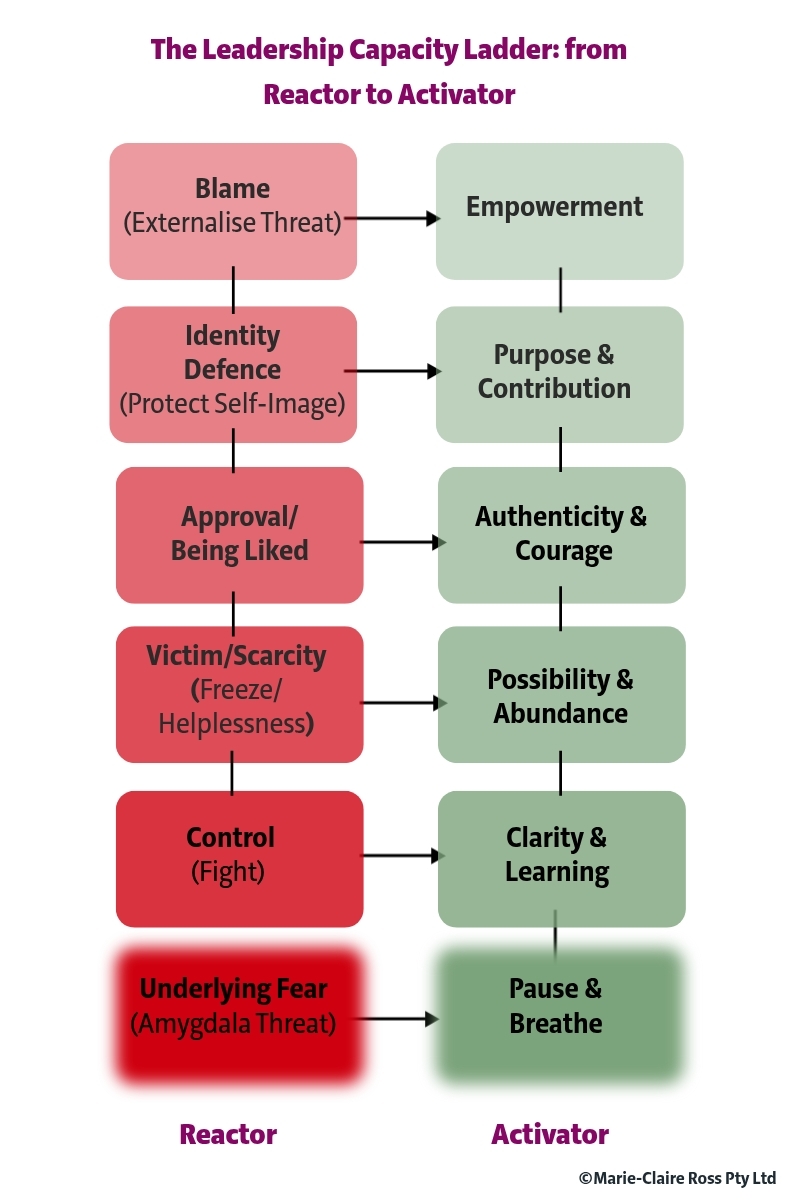
On this side, your reactions are fast, automatic, and defensive. You usually jump straight to one or more of the reactive rungs:
Control – “I must fix this myself. I can’t trust others to handle it.”
Victim/Scarcity – “We don’t have enough time, people, or resources. There’s nothing we can do.”
Need for Approval – “If I fail, they won’t respect me. I have to look in control.”
Identity Defence – “This proves I’m not good enough. I can’t afford to be wrong.”
Blame – “This is their fault. Why can’t they get it right?”
These reactions can look decisive in the moment, but they narrow thinking, reduce psychological safety, and keep teams stuck in threat mode - especially during periods of workplace change or crisis.
On the Activator side, leaders still feel the stress - but they don’t let it run the show.
Stress becomes a signal to slow down internally, rather than speed up externally. From this steadier internal position, leaders choose responses that open thinking instead of closing it.
Pause & Clarity
Activator leaders interrupt the reflex to react quickly in order to look decisive. They take a brief internal pause - even just six seconds - to regulate their nervous system.
In that pause, they reach for grounding thoughts such as:
This reset allows them to ask clearer questions:
From there, they can intentionally step onto other rungs of the ladder to get people thinking differently about the issue at hand or even themselves
Learning & Possibility – “What can we learn from this? What might this open up?”
Authenticity & Courage – “How can I name what’s hard without attacking or collapsing?”
Purpose & Contribution – “What matters most right now? How can we create value together through this change?”
Empowerment – “How will the wiser future version of me – and my team – navigate this?”
Any rung on the Activator ladder is a better choice than staying stuck on the Reactor side. This isn’t about being perfect or “always empowered.” It’s about choosing capacity over protection in the moment.
Your brain is wired to default to the Reactor ladder. Under stress, the amygdala — the brain’s threat centre — hijacks thinking and pushes you toward fight (control, blame), flight (avoidance, appeasing), or freeze (victim, stuck).
Activator leaders unlearn some powerful assumptions:
Instead, they practice a different pattern. They:
The result is a calm, grounded leadership presence that helps others feel safer and think more clearly. Teams recover faster, take greater ownership, and are more willing to speak honestly during workplace change.
Many high-achieving leaders become successful through Reactor behaviours — control, urgency, image management. But over time, the costs accumulate:
Reactors focus on surviving the threat.
Activators focus on creating from it.
Imagine a missed deadline during a major change initiative.
Reactor path: Fear → Control ("Fix it now!") → Blame ("Why can't you get this right?").
Activator path: Fear → Pause → Possibility ("What opportunity does this reveal?") → Empowerment ("How will we all grow capability through this?").
The Activator doesn’t ignore the problem. They reframe it, involve others, and strengthen the team’s capacity to handle future challenges. Results still matter - but so does honesty and resilience.
The next time workplace change triggers pressure, notice your default Reactor rung. Then deliberately step across and ask the matching Activator question.
Over time, this rewires your response - from reactive leadership to creative, grounded leadership.
Leaders don’t rise by avoiding fear.
They rise by choosing a better ladder.
Which rung will you step onto next?
If you want to know more about how to be an Activator leader, then come and join my free webinar on 10 March. It will be filled with tips and tricks. If you can't make it, register anyway and you'll receive the recording.
The best safety professionals that I've worked with like safety. They read all the right safety magazines and go to all the right safety...
As a safety professional, it's vital that you can get your fellow workers in alignment with the company safety goals, so that everyone is working...
In the book, A Whole New Mind by Daniel Pink, he compares both the left and right hemispheres of the brain and discussed that you need to include...