








5 Secret Strategies of Smart Leaders
Get five helpful tips of smart leaders.

Develop leaders, strengthen executive teams and gain deep insights with assessments designed to accelerate trust and performance.

Transform how your leaders think and perform with keynotes that spark connection, trust and high-performance cultures.

Explore practical tools, thought-leadership and resources to help you build trusted, high-performing teams.

Trustologie® is a leadership development consultancy founded by Marie-Claire Ross, specialising in helping executives and managers build high-trust, high-performing teams.

5 min read

Navigating difficult conversations at work isn’t just a “nice to have” leadership skill – it’s the fault line that often separates healthy, high‑performing teams from exhausted, resentful ones.
Frequently, when I run leadership workshops with groups of executives or managers, someone will admit how hard they find it to have a difficult conversation with a poor performer. The room usually goes quiet, and you can feel the shared discomfort. Most leaders know a conversation needs to happen; they’re just not sure how to do it without making things worse.
It often comes up when I explain that leaders who don’t hold people to account can unwittingly create what I call an Abatement Zone team – a team where standards slowly erode, high performers switch off, and “good enough” becomes the norm.
I unpack this more fully in 7 Steps to Move Teams Out of the Abatement Zone, but the core issue is this: avoiding difficult conversations doesn’t protect people. It quietly harms everyone.
Emotionally intelligent leaders approach these moments differently. They don’t see difficult conversations as battles to win, or opportunities to prove they’re the boss. They see them as chances to deepen understanding, clarify expectations, improve team member capabilities and protect the long‑term health of the relationship and the team. It’s a completely different mindset.
And that mindset starts long before you open your mouth.
People can tell when a performance conversation is coming from ego. If your real intention is to vent your frustration, defend your status, or show that you’re better than the other person, your tone, body language, and word choice will give you away.
If you are coming from fear, you are coming from ego. You are making it about you.
The shift toward emotional intelligence is moving from, “How do I protect myself?” to “How do I support this person and the team?” It’s moving from being “the boss” to showing up more like a wise, honest friend – someone who can be clear and kind at the same time.
Honestly, if more people did this (especially politicians), we'd have a much more collaborative and peaceful world.
With that in mind, here are three ways emotionally intelligent leaders reduce the impact of ego and keep difficult conversations focused on growth rather than self‑protection.
A lot of leaders avoid difficult conversations because they’re afraid:
Fear is human. The problem is what you do with it.
You are focused on:
Meanwhile, the other person is scared too. They may be worried about their job security, their reputation, or whether they’re about to be humiliated. For some people, when they get scared, they lash out. We tend to make this worse, if they can sense that we are scared or we are out to hurt them. It makes them feel threatened.
When you’re wrapped up in your own fear, you miss their fear. You can’t lead someone you’re not truly seeing.
An emotionally intelligent leader pauses to ask:
Simply naming your own fear (“I’m worried this will be awkward,” “I’m anxious they’ll react badly”) reduces its grip and helps you shift your focus back to the person in front of you.
Ego wants to protect your image: to look competent, in control, and unbothered. That’s when you see behaviours like:
In the moment, these reactions can feel justified – especially if you’ve just received negative customer feedback or your own reputation is on the line. But when your primary goal is to protect how you look, you are no longer focused on helping the other person grow. They experience you as unsafe, shaming, or unpredictable. That’s when complaints end up in HR and trust quietly erodes.
If you recognise yourself in this pattern, sit with questions like:
Emotionally intelligent leaders make a different choice: they focus on growing the person’s potential, not guarding their own image. People are far more likely to trust you when they can feel that you genuinely have their best interests at heart.
You can support this shift by silently asking yourself before you speak:
This moves you out of performance mode (“I must prove I’m in control”) and into a growth mindset (“I’m here to help you become who you’re capable of being”). Your tone softens, your body language opens, and the other person is much more able to stay present, hear you, and use the conversation as a springboard for development.
Many leaders tell me, “I’m different at work than at home,” and they say it like a badge of honour. But if your “work self” is cut off from your natural warmth, humour, and care, you’ve actually put yourself at a disadvantage for difficult conversations.
Ask yourself:
With a friend, you’re more likely to say things like:
“I’m raising this because I care about you and I know you’re capable of more.”
“This isn’t about you being a bad person; it’s about a behaviour that’s getting in your way.”
At work, ego can convince us that we must be tougher, colder, or more distant to be “professional.” In reality, that distance often makes conversations more brittle and more frightening for everyone involved.
Bringing more of your “friend self” into leadership doesn’t mean abandoning boundaries or standards. It means allowing your empathy, curiosity, and belief in the other person to be visible. When people can feel that you’re on their side, they are far more willing to hear hard truths and take responsibility for change.
Difficult conversations will never feel completely comfortable—and they’re not meant to. Discomfort is often the sign that you’re talking about something that matters.
But they don’t have to be destructive.
When you notice your fear and ego, shift your focus from protecting your image to protecting the relationship, and bring more of your “friend self” into the workplace, you create the conditions for honest, growth‑oriented dialogue. You stop using conversations to prove you’re in charge and start using them to build courage, clarity, and trust on your team.
Over time, this changes more than just how a single conversation goes. It changes your culture. People learn that tough topics can be raised without fear of humiliation. It creates intellectual honesty which is the main benefit of psychological safety. Accountability becomes a shared norm, not a rare event. And performance conversations become a natural part of how you help each other succeed - not something everyone dreads and avoids.
Feeling like you’re doing all the work and still dragging people along? In my free webinar Stop Managing. Start Leading., I’ll show you how to shift out of the Doing loop and lead from presence, so people step up without being pushed. Register here.
If you’d like to keep developing your confidence with difficult conversations, these articles work well together:
The future of leadership involves leaders who have the capabilities to create a cohesive work environment.
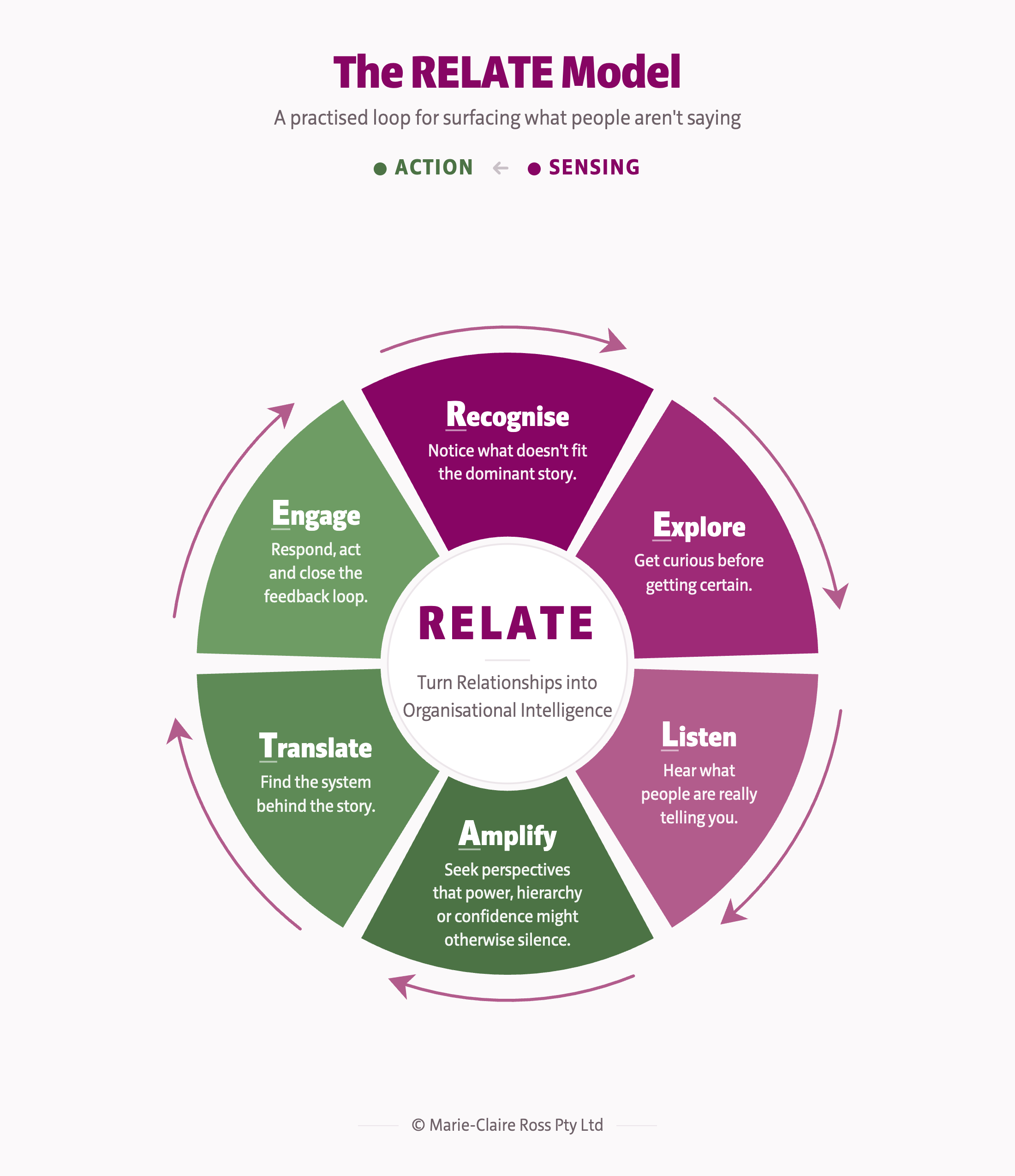
Learn how positive working relationships help leaders access honest information, invite challenge and reduce blind spots using the six-step RELATE...