










The Achievement Zone Model
Discover how The Achievement Zone Model can transform you leadership and team performance.
Trusted by companies worldwide.



What is The Achievement Zone?
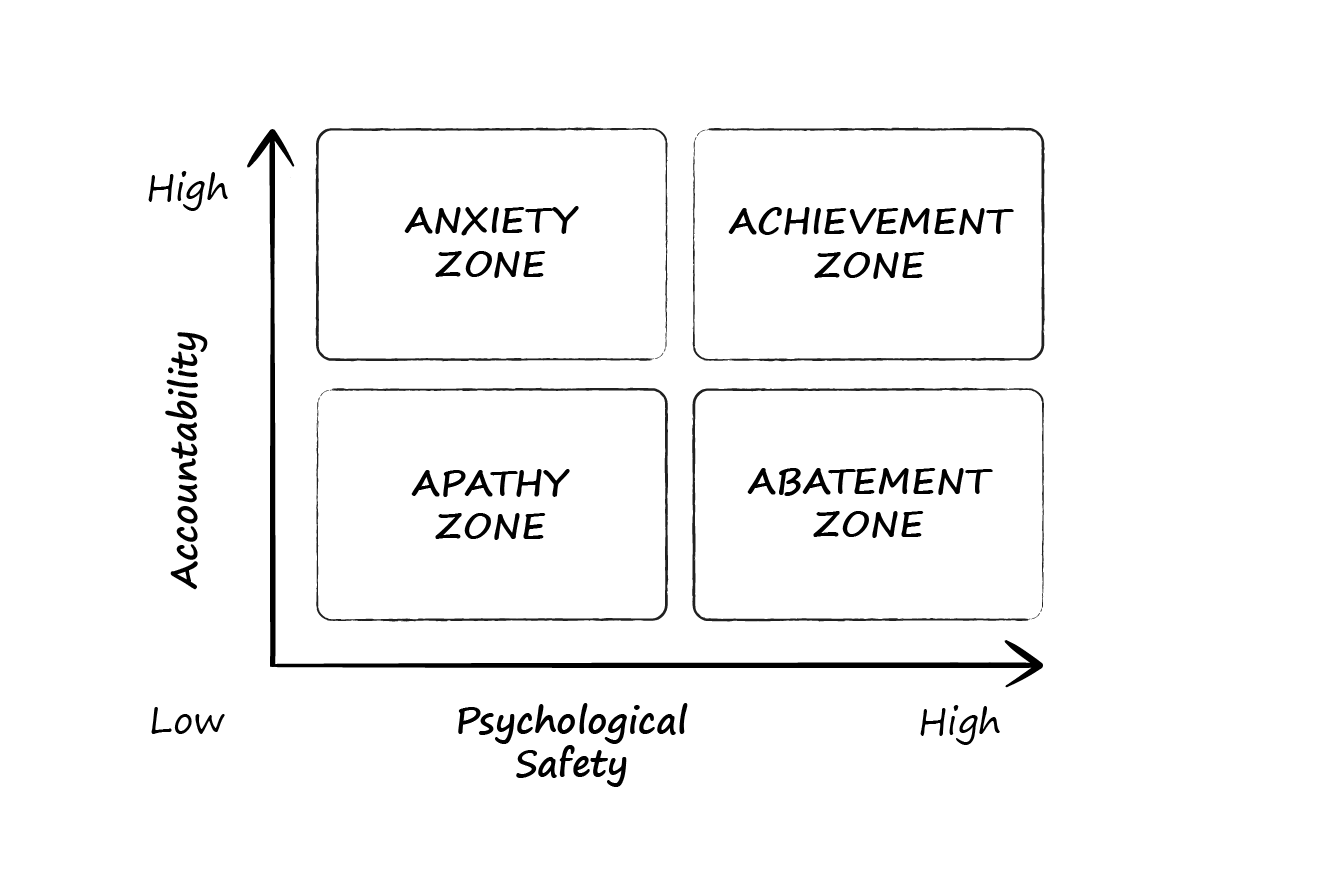
The Achievement Zone Model is a four-quadrant framework that diagnoses team performance by mapping psychological safety against accountability.
The Achievement Zone features in the book, Trusted to Thrive: How leaders create connected and accountable teams.
It is used by CEOS, senior leaders, teams, managers and People and Culture leaders to see, in one glance, why their team is not performing and which behaviours will move them.
At the heart of the Achievement Zone Model is a fundamental, age-old leadership tension.
When leaders over-index on results, people often become cautious. They hold back ideas, avoid risk, and protect themselves. When leaders over-index on comfort, standards begin to drift. Deadlines move, accountability weakens and performance declines.
As a result, many leaders oscillate between the two - tightening expectations when results slip, then easing pressure when engagement drops.
This dynamic is often experienced as a trade-off. It is not.
The Achievement Zone Model helps create a team environment that effectively manages productive tension.
Accountability creates directional force: delivering results, meeting standards, and following through on commitments. Psychological safety creates relational openness: speaking up, challenging ideas, and admitting mistakes without fear of negative consequences.
When either dimension is underdeveloped, performance is compromised. Excessive emphasis on accountability without safety leads to defensiveness and disengagement. While excessive emphasis on safety without accountability leads to ambiguity and underperformance.
High-performing teams have learnt to manage the tension. And it all starts with the leader.
Where the Achievement Zone Model Originated
The genesis of the model is from the work of Amy Edmondson, the Harvard Business School professor whose research established psychological safety as a measurable lever of team performance. Edmondson's original framework discusses the tension between psychological safety and high standards.
In research I undertook with senior leaders and managers across Australia and globally, I found that it wasn't so much high standards that was causing friction. It was accountability - being held to high standards, getting work done on time and to budget. The Achievement Zone Model extends Edmondson's thinking and goes into detailed exploration of the different team zones accountability and psychological safety create.
In my research and work with teams, I found that both psychological safety and accountability are modelled and managed by the team leader. The way a leader models and rewards behaviour creates the culture in which a team operates. Ensuring people feel safe isn’t enough to lift performance, nor is solely focusing on results; there needs to be a balance between the two.
A study by Zenger and Folkman backs this up. There research analysed 400,000 360-degree survey results. They found that the most successful leaders possessed a powerful combination of competencies. Of leaders in the top quartile, 66% possessed both a focus on results and interpersonal skills (the ability to develop and maintain relationships). Meanwhile, only 13% of leaders who focused on results alone and only 9% of leaders who focused on interpersonal skills alone reached the 90% percentile.
These four zones represent where we are currently performing and the impact that has on our teams. You might notice the zones also represent where team members are located and the overall performance of your team.
Let’s unpack these four zones in more detail.
The Four Zones of Team Performance
As we step into more demanding leadership roles, the weight of the decisions we make and the impact on others get bigger. Constant demands and the changing business needs of your role can become overwhelming, exhausting and almost suffocating.
While we might feel like we are leading an Achievement Zone team circumstances outside of our control test us.
Let's unpack these four zones in more detail
The Apathy Zone (low safety, low accountability)
This is the zone of disengagement. Energy is spent on self-preservation, not on the work. People are tired, cynical, and quietly looking for a way out. Blame is high. Trust is out the door.
Apathy Zone teams typically appear in one of two settings. The first is under an emotionally volatile leader who has shut their team down. The second, and more common in senior teams, is under-management. The leader avoids difficult conversations, misses meetings, ignores escalations, and lets the team drift. People feel ignored, unsupported, and unsure whether their work is right.
It is the zone where customers churn before the leader notices.
The Abatement Zone (high safety, low accountability)
This is the zone of comfortable underperformance. It is quite common. The team is friendly, engagement scores look healthy, and the leader is well-liked. Nothing improves. Performance is abating. Ideas go to die in meetings.
Abatement Zone teams are particularly common after a big win. The team is coasting on the reputation it built five years ago. High performers inside the team get quietly resentful. They watch peers operate at half-speed and begin to disengage themselves.
It is the most dangerous zone for a senior leadership team because it looks healthy on the dashboard.
The Anxiety Zone (low safety, high accountability)
This is the zone of high productivity. These teams hit their numbers, earn praise and are held up as the high-performance example. Work is getting done but it can be at the cost of stress, mental health and hiding mistakes.
This team is created by a leader who is all about results, but not so much people. Team members often feel alone in handling excessive workloads. Stress, presenteeism, and turnover climb. Often, unreasonable client demands and a company culture of doing more results in Anxiety Zone teams.
Anxiety zone teams are often unavoidable in high-pressure environments. The trick is ensuring that they are sustainable which is what an Achievement Zone leader does.
The Achievement Zone (high safety, high accountability)
The Achievement Zone is the place we all crave as humans. It’s a supportive environment where people solve hard problems, explore new ideas, challenge one another and focus on continuous improvement. It’s where we believe that as a team we can achieve anything together.
It is led by a leader who is intentional about staying in the Achievement Zone. They do the work to keep themselves there, knowing that will encourage team members to join them.
Inside the Achievement Zone, work feels like play. The team pushes for stretch goals because they trust the people around them. Meetings are dynamic. Decisions move fast. Difficult conversations happen without scarring.
The Achievement Zone is unstable. External shocks pull teams out of it. Internal change pulls leaders out of it. The leader's job is not to stay in the Achievement Zone. The leader's job is to learn how to return.
"The Achievement Zone Model has been a useful exercise for the leadership team to discuss and think about where we are individually and as a team. We all have some great tools to use moving forward that will enable us to execute on strategy."
CEO, Midsize Industrial Organisation
"I really like the Achievement Zone model. It's helped me work out which levers I can move in the team. It's also given me some really good strategies to ensure that I'm performing at this level more sustainably. I enjoyed going through the self-assessment and unpacking what I need."
Director, Accountancy Firm
"It has been beneficial to see all our leaders at different levels have some deep discussions about their team performance. There has been a lot of note taking and leaders eager to implement steps from their action plan."
Head of L&D, Local Government
How the Achievement Zone is Used
- How to lead yourself, and your Team into the Achievement Zone (workshop and keynote).
- As a team and leader assessment tool.
- In a training workshop on how to shift team dynamics.
- It also form part of the core curriculum in my Tribe of Trusted Leader's leadership development course.
If you are reading this and recognising your team in the Apathy, Abatement, or Anxiety Zone, you are not alone. Most senior leadership teams and project teams realise they are struggling to stay in the Achievement Zone sustainably.
The fastest way in is to run an Achievement Zone Team Building Workshop with your team. We diagnose your zone, we map the gap, and you get practical tools to help yourself and your team.
FAQ
-
What is the Achievement Zone Model?
The Achievement Zone Model is a four-quadrant framework that diagnoses team performance by mapping psychological safety against accountability. The four zones are Apathy, Abatement, Anxiety, and Achievement. It is used by senior leaders to see why their team is not performing and which behaviours will move them.
-
Who created the Achievement Zone Model?
The Achievement Zone Model was developed by Marie-Claire Ross, founder of Trustologie and author of Trusted to Thrive. It draws on Amy Edmondson's research on psychological safety and is shaped by Marie-Claire's two decades of fieldwork inside Australian executive teams.
-
What does it take to lead a team into the Achievement Zone?
Getting your team into The Achievement Zone is all down to you. The leader - how you guide, inspire and support others. It starts with your MINDSET - how you perceive your role, collaborate with managers, navigate challenges, embrace ambiguity, and your readiness to continually enhance your abilities.
-
What are the main pillars to keep a team in the Achievement Zone?
Achievement zone leaders foster a supportive environment where employees learn and work together, focus on continuous improvement and explore exciting new possibilities.
The key themes are around envisioning a positive future, being curious, focusing on continuous improvement, being accountable and stretch goals. Creating a team culture that is excited about what they are doing together and why. -
Who is best suited to learn about the Achievement Zone model?
Leaders and employees love talking about which zone they are operating in and the team. It's a good way to have an honest discussion about team performance that incidentally improves safety (with the right leader approach).