







1 min read
7 BEST PRACTICES OF HOW HIGH-IMPACT LEADERSHIP PROGRAMS ARE STRUCTURED
In last week's article, 4 Key Features that Confirm a Quality Leadership Development programwe explored the essential features to consider when...

Develop leaders, strengthen executive teams and gain deep insights with assessments designed to accelerate trust and performance.

Transform how your leaders think and perform with keynotes that spark connection, trust and high-performance cultures.

Explore practical tools, thought-leadership and resources to help you build trusted, high-performing teams.

Trustologie® is a leadership development consultancy founded by Marie-Claire Ross, specialising in helping executives and managers build high-trust, high-performing teams.

3 min read
When most people hear the term leadership accountability, they often picture a manager holding others to account - calling out missed deadlines, chasing performance, or running yet another check-in meeting.
But accountability in leadership is about far more than checking boxes or correcting people. It's about creating the conditions where trust, ownership, and excellence can thrive—at every level of a team or organisation.
In my work with leaders and teams, I’ve seen how accountability often breaks down not because people don’t care, but because expectations are unclear, follow-through is inconsistent, or accountability is treated as a one-way street.
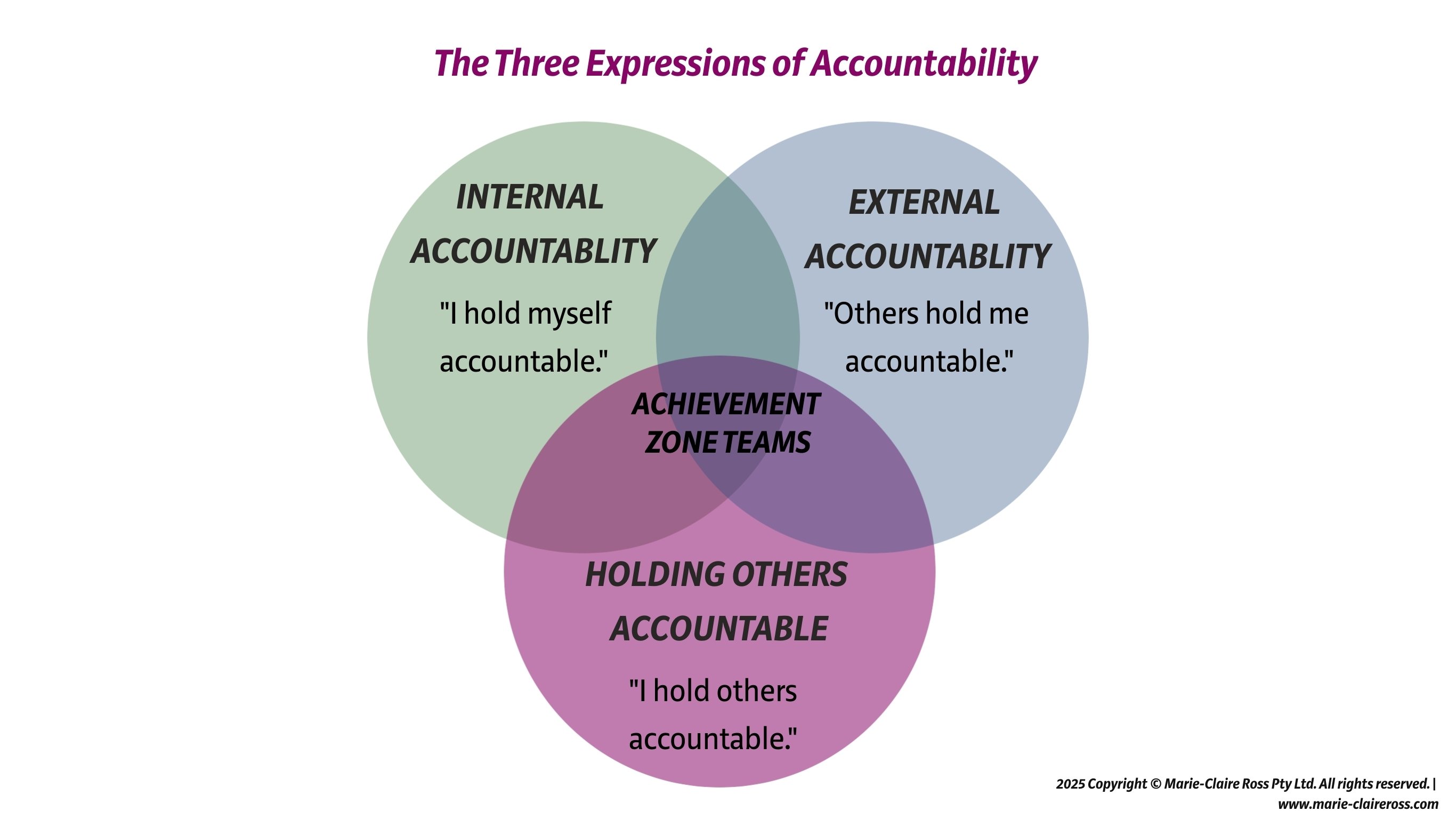
To truly strengthen accountability in leadership, we need to think about it in a more integrated manner. There are three expressions of accountability that, when practised together, lay the foundation for a culture of integrity, growth, and mutual support.
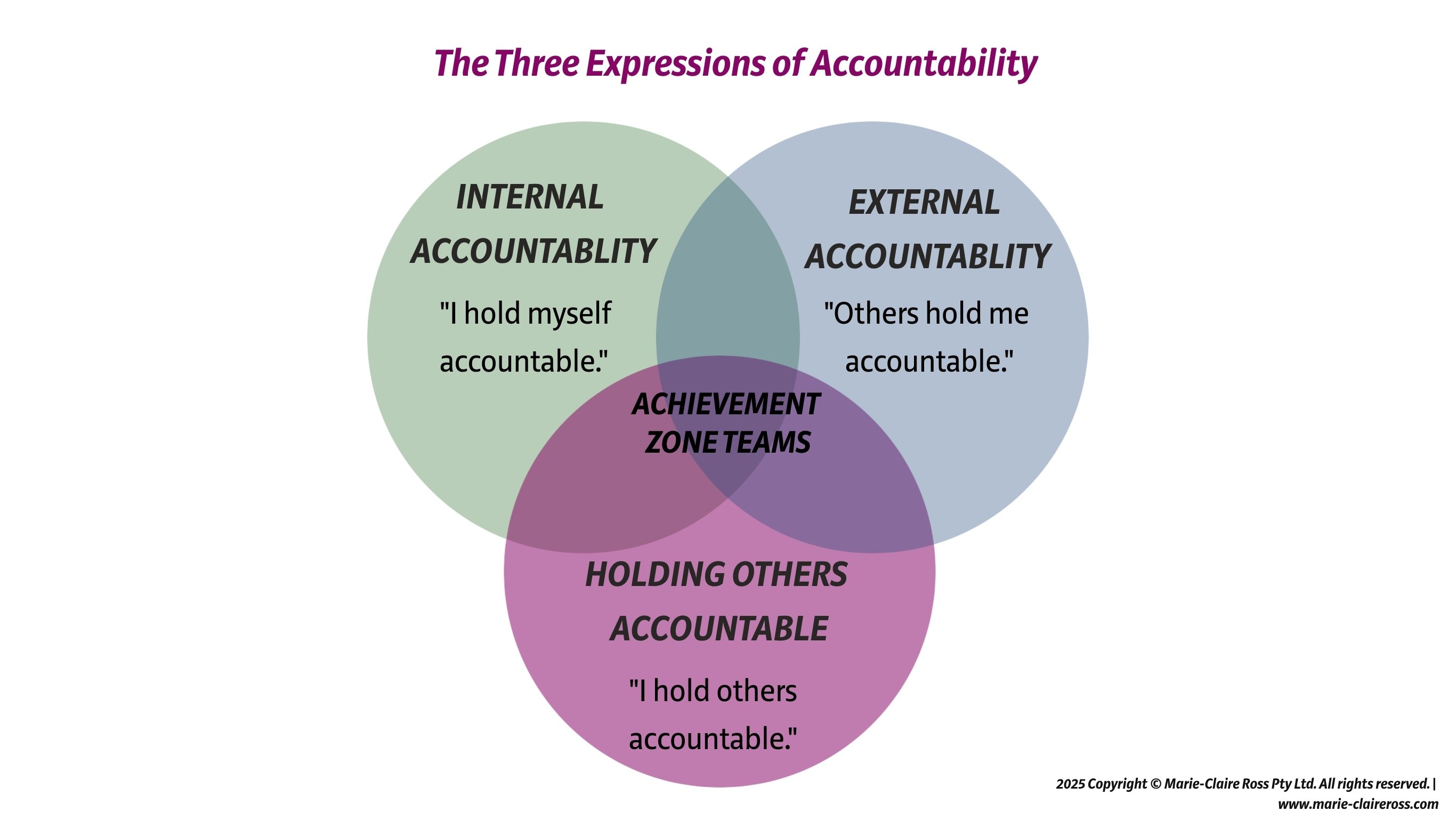
Let’s take a look:
At the heart of leadership accountability is the ability to lead yourself first. Internal accountability means taking ownership of your actions, your mindset, and your impact. This requires personal responsibility and drive to meet high standards and to keep going when things get tough. It’s about doing what you said you’d do—not because someone is watching, but because you believe it matters.
When leaders consistently hold themselves accountable, they build credibility. Their team trusts them more. And just as importantly, they model the kind of behaviour they expect from others.
Without internal accountability, leadership becomes reactive. Challenges are deflected, feedback is avoided, and self-doubt can drive decision-making.
There is also no personal growth.
Without self-awareness, accountability becomes external and reactive—people only act when pushed, or when consequences are enforced.
But with self-awareness, accountability becomes internal and proactive. People take ownership, admit mistakes, and adjust without being told.
This builds trust, improves performance, and contributes to a culture of integrity—where accountability isn’t a threat, but a shared commitment to doing better together.
Reflection question:
“How did I show up today? Did I lead in a way that built trust and progress?”
Accountability in leadership isn’t just about holding others to account—it also means allowing yourself to be held accountable by the people above you.
This requires proactively setting up regular one-on-one's, clarifying strategic goals, and seeking alignment with your own leader—rather than resisting performance metrics, working in isolation, or assuming expectations are fixed. When leaders don’t ask for clarity, they often default to confusion, frustration, or defensiveness.
Being held accountable is a sign of strength—not weakness. It shows you're invested in outcomes, open to feedback, and committed to evolving how you lead.
As an executive coach, I am often brought in to help high-performing founders stay accountable to their big goals. This is important as research by the American Society for Training and Development (ASTD) shows that having scheduled accountability check-ins with a partner boosts your chances of achieving a goal to 95%, compared to just 50% if you only create a clear plan on your own.
Reflection question:
“Have I created regular space to align with my own leader on goals, priorities, and performance expectations?”
This is where leadership accountability becomes cultural—not just individual. Holding others accountable isn’t about being critical or controlling. It’s about creating the psychological safety and team standards that help everyone succeed.
That means noticing when someone is slipping, but also caring enough to ask why. It means giving feedback early, not bottling it up. And it includes creating a team environment where peer-driven accountability thrives—where people feel safe to challenge, support, and speak up for what matters.
This is where every team member knows that they are accountable to each other.
When this is missing, silence takes over. Teams may look harmonious on the surface, but performance, trust, and wellbeing quietly erode.
Reflection question:
“Have I built a team culture where people feel safe to speak up—and responsible for supporting one another’s success?”
When leaders practise all three expressions of accountability—
This is where psychological safety and accountability meet—and where high performance becomes sustainable.
In the Achievement Zone Model™, people feel safe to speak up, make mistakes, and challenge ideas because they also know that goals matter, standards are clear, and follow-through is expected.
These teams are grounded in trust, fuelled by purpose, and driven by shared ownership. They don’t just talk about values—they live them. They get results without blame, burnout, or breakdown.
The result? People stretch without snapping. They perform with clarity, and they grow—together.
Leadership accountability is more than just holding others to account. It starts with how you show up, continues with how you stay aligned with your boss' expectations, and expands to how you support and stretch your team.
When all three expressions of accountability are present, you move from compliance to commitment—building trust, lifting performance, and creating a culture where people want to succeed.
Ask yourself: Which part of accountability do I practise well? And where do I need to grow—so my team can grow too?
That’s how you lead teams into the Achievement Zone.
If your team is ready to strengthen accountability in a way that also builds trust, clarity and shared ownership, my team building workshop offers a practical next step.


1 min read
In last week's article, 4 Key Features that Confirm a Quality Leadership Development programwe explored the essential features to consider when...

1 min read
In a recent Fast company article, Dr. Tomas Chamorro-Premuzic made the bold statement that an under-rated leadership skill is being able to build a...
1 min read
In an era defined by rapid change, economic uncertainty, and unprecedented workplace challenges, organisations are grappling with how to remain...