




1 min read
Research suggests this is how to build a high performing team
In a recent Fast company article, Dr. Tomas Chamorro-Premuzic made the bold statement that an under-rated leadership skill is being able to build a...

Develop leaders, strengthen executive teams and gain deep insights with assessments designed to accelerate trust and performance.

Transform how your leaders think and perform with keynotes that spark connection, trust and high-performance cultures.

Explore practical tools, thought-leadership and resources to help you build trusted, high-performing teams.

Trustologie® is a leadership development consultancy founded by Marie-Claire Ross, specialising in helping executives and managers build high-trust, high-performing teams.

6 min read
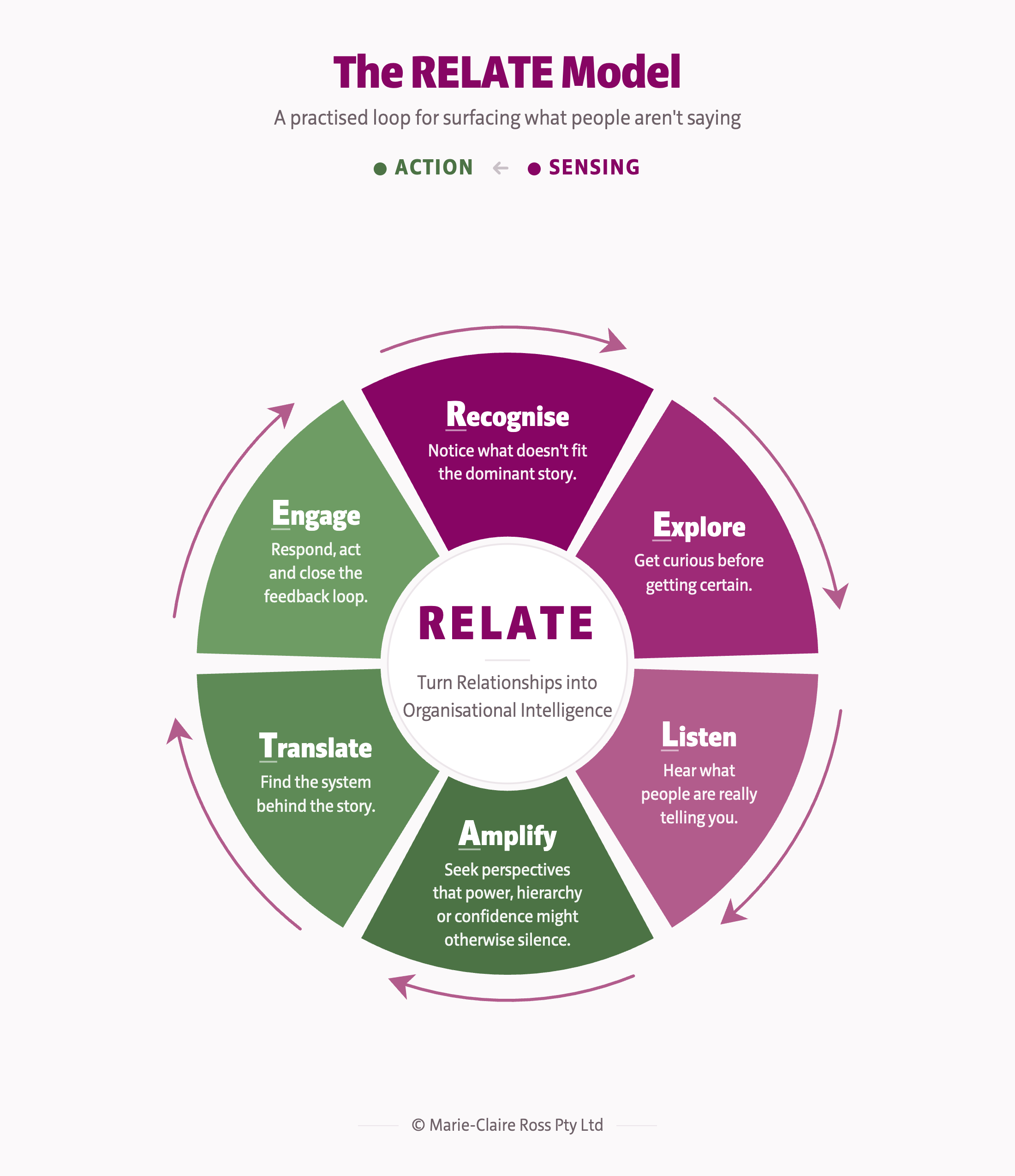
Introducing the RELATE model for building trust, inviting challenge and seeing beyond organisational blind spots.
The more senior a leader becomes, the more important relationships become. Yet as we climb the career ladder, we often disconnect from our workplace relationships and diminish their importance.
This can inadvertently create blind spots.
Positive working relationships help leaders access honest information, invite constructive challenge and see risks that formal reports may miss. The six-step RELATE model shows you how to build them at work.
Senior leaders may believe they have a clear view of the organisation when reports arrive on time, meetings are orderly and answers sound confident. Yet information is shaped by the relationships through which it travels. Trusting relationships widen a leader's view; strained or overly deferential relationships narrow it.
Information passes through layers of interpretation, incentives, hierarchy and fear as it moves towards the top of an organisation. By the time it reaches the executive table, it may be accurate. Or it may be the version people believe is safest, most useful or most acceptable to share.
To make sure you don't get caught making the wrong assumptions, the most important leadership question is not "What do I know?" but "Who helps me know what I cannot see for myself?"
Positive working relationships aren't simply about getting along with people. For leaders, their real value is what they make possible: honest information, constructive challenge and perspectives you might otherwise miss.
Leaders never see the whole organisation from a single position. Employees experience different customers, processes, pressures and informal realities. They notice workarounds, emerging risks, unresolved tensions and unintended consequences that may not appear in reports or formal meetings.
The quality of your relationships determines the quality of information you have access to as a leader.
When people trust a leader's intentions and responses, they are more likely to:
This is why positive working relationships are more than a pleasant feature of workplace culture. They form part of a leader's organisational intelligence system.
Research on psychological safety and employee voice supports this connection. Employees are more likely to express ideas, concerns and warnings when leaders create conditions of inclusion, trust and interpersonal safety. Inclusive leadership is also associated with employee voice, particularly when people believe their perspectives will be respected and taken seriously.
However, positive relationships should not be confused with relationships in which everyone agrees or conflict is avoided. That's what I call the Abatement Zone and it's disastrous for high performance.
A relationship can be warm and cordial while still lacking candour. Leaders need relationships strong enough to hold disagreement, challenge and difficult information.
You might think of the difference this way:
A comfortable relationship may give you reassurance. A trusting relationship gives you access. A candid relationship gives you information you may not otherwise receive.
This is the real leadership value of cultivating positive working relationships. They help leaders see beyond their own perspective and access the distributed knowledge of the organisation.
In her book Cultivate: The Power of Winning Relationships, author Morag Barrett presents four working relationship dynamics that ensure leaders aren't making decisions in a bubble:
1. Allies support you while still being willing to tell you what you need to hear, including the difficult messages others may avoid. I also call these "feedback friends." These are people you can honestly ask for specific feedback on what you need to improve and who will work with you, not against you.
2. Supporters may have valuable insights but hold back from challenging your perspective, particularly when your seniority makes your view the HIPPO, the Highest Paid Person's Opinion, in the room.
3. Rivals can expose weaknesses in your thinking and offer the challenge that more agreeable colleagues may not.
4. Adversaries may still provide information that strengthens your decisions, if you are willing to listen without dismissing the messenger.
The goal is not to surround yourself only with people who agree with you. It is to understand which relationships broaden your perspective, and which may be reinforcing your blind spots.
That's why I developed RELATE. It's a practical framework for building the kind of relationships that give leaders access to information they can't get from reports, dashboards or formal meetings.
RELATE is about six leadership disciplines: recognising what doesn't fit, exploring before concluding, listening without defensiveness, amplifying perspectives you might otherwise miss, translating individual experiences into system insight, and engaging in a way that closes the loop.
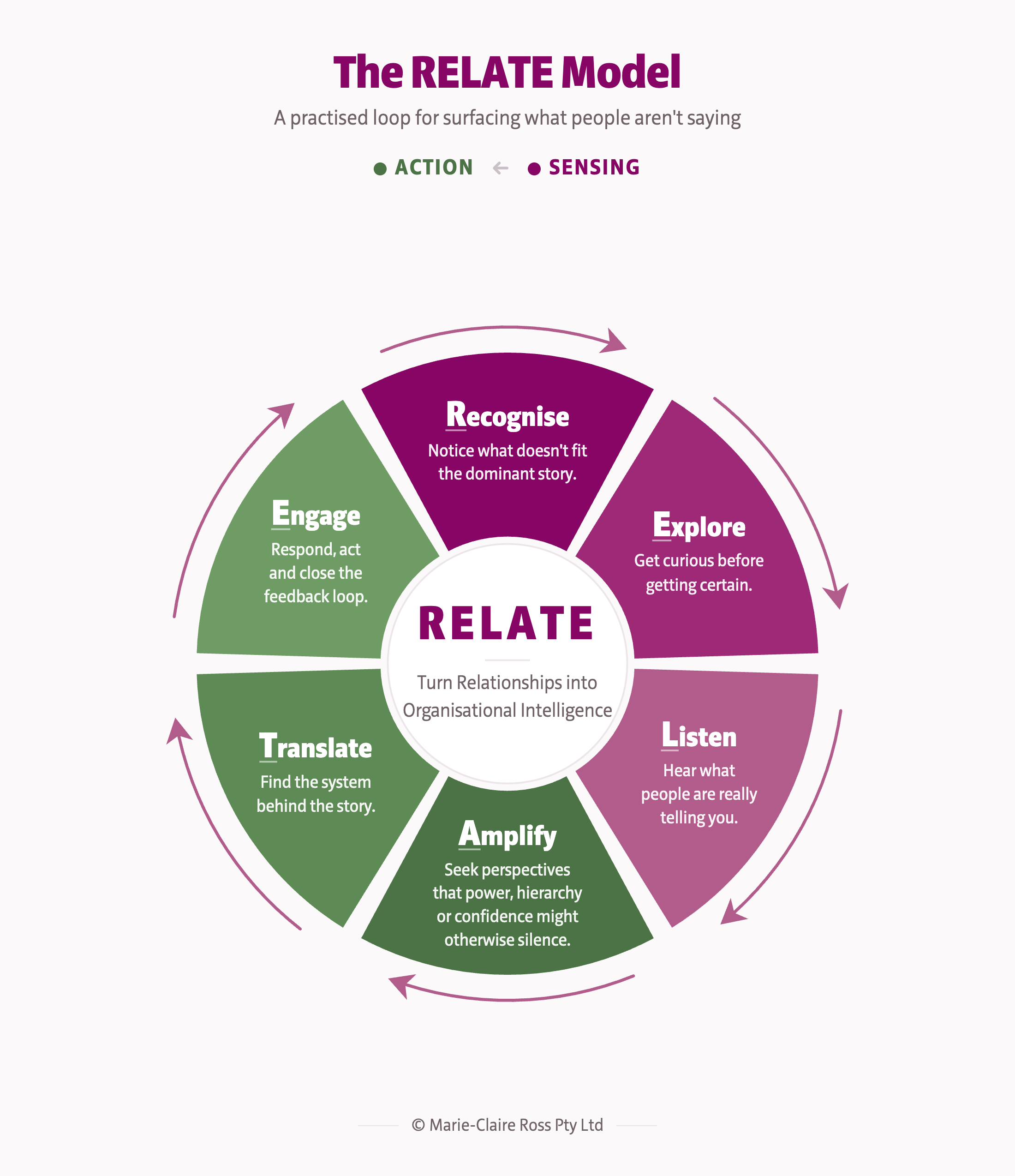
Fostering healthy relationships begins with being present and attuned to what is happening around you. Pay attention to more than the words people use. Notice what you observe and feel, then use metacognition (examining your own assumptions and interpretations) to explore the patterns shaping the situation.
When you act on what you notice, people see that you care and that their concerns won't be dismissed when something isn't working.
Let me take you through the six steps:
Blind spots often begin with something small that doesn't fit the story you're being told.
A leader might notice:
Useful question: What am I noticing that does not fit the official narrative?
Senior leaders are particularly vulnerable to premature certainty. The more senior you become, the more likely people are to give you answers that reinforce your existing view. It then becomes more tempting to interpret ambiguous information quickly.
Explore is about curiosity and asking before you assume.
Useful questions include:
Listening is where many leaders lose the information they asked for. They invite candour and then immediately explain why the concern is not valid.
A raised eyebrow, a quick explanation, a defensive question or "that's not how it happened" can be enough to teach someone not to bring you that information again.
A leader who wants the full picture must first understand the person's experience:
The people with the most influence in the room aren't necessarily the people with the most useful information.
Status, tenure, hierarchy, personality and confidence all influence who speaks and who stays silent.
Amplification is more than inviting "all voices" in a meeting. It means actively correcting for power, status and confidence differences.
For example:
This is particularly relevant in multi-generational teams, where tenure, technical confidence and assumptions about hierarchy may shape who speaks first and who remains silent.
One person's experience is data. Your job is to understand what it might be telling you about the system.
For example, "the new process takes too long" might indicate:
Don't ask only:
"What's the problem?"
Ask:
"What does this problem tell us about how the organisation is working?"
The moment after someone tells you something uncomfortable is a relationship-defining moment.
If nothing happens, people learn that speaking up isn't worth the risk. If you respond with curiosity, explain your decision and follow through, you teach people that their voice matters, even when you don't agree with it.
Voice without response can reduce trust. Employees need to know what happened after they contributed information.
The leader does not need to act on every suggestion. But they should explain:
This is how relationships become a reliable source of intelligence rather than a one-way extraction of information.
Positive working relationships aren't relationships without disagreement. They're relationships where disagreement doesn't threaten the relationship.
Leadership blind spots are not solved by collecting more information alone. They are reduced when leaders build relationships that make different information possible. RELATE offers a practical discipline for doing that: recognise what does not fit, explore before concluding, listen without defensiveness, amplify overlooked perspectives, translate individual experiences into system insight, and explain how you will act.
The question is not whether people around you have noticed something you have missed. They probably have. The question is whether your relationships make it safe, worthwhile and possible for them to tell you.
Next week, I'll look at how to use RELATE in one-to-one conversations, team meetings, multi-generational teams and other workplace interactions.
Positive working relationships are built on trust, psychological safety, candour and accountability. They allow people to share concerns, challenge assumptions, admit mistakes and contribute ideas without fearing dismissal.
They help leaders access information that may not appear in reports or formal meetings. Strong relationships make it more likely that employees will raise risks early, offer constructive challenge and explain how work really gets done.
Use the RELATE model: Recognise what does not fit, Explore before concluding, Listen without defensiveness, Amplify overlooked perspectives, Translate individual experiences into system insight, and Engage by closing the loop.
A comfortable relationship may provide reassurance, while a trusting relationship gives you access to honest information and constructive challenge. Trust does not remove disagreement; it makes disagreement safer to express.
1 min read
In a recent Fast company article, Dr. Tomas Chamorro-Premuzic made the bold statement that an under-rated leadership skill is being able to build a...
1 min read
Trust in business is foundational. It underlies every human relationship, every interaction, every communication, every initiative, every work...
.png)
1 min read
Every single moment our brains are scanning our environment and calculating whether we can trust the people around us.