

1 min read
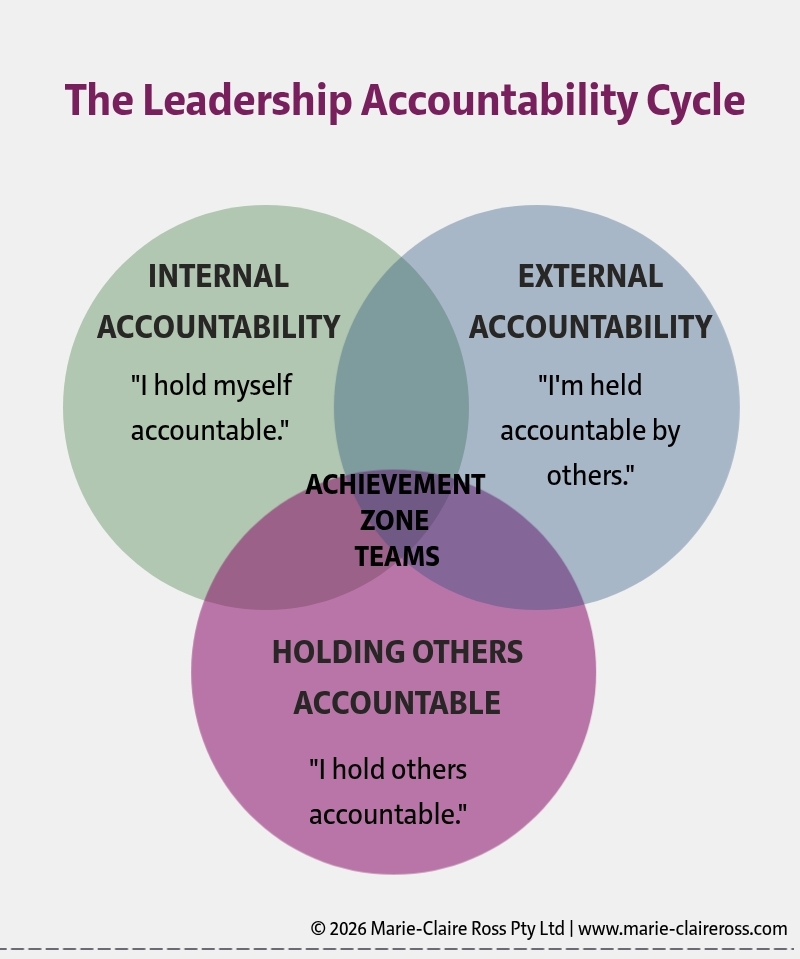
Why Leaders of Leaders Need to Actually Hold Their Teams Accountable
Whether you're a CEO, GM, or senior leader managing other managers, here's what to hold your leaders accountable to (without micromanaging).
Develop leaders, strengthen executive teams and gain deep insights with assessments designed to accelerate trust and performance.

Transform how your leaders think and perform with keynotes that spark connection, trust and high-performance cultures.

Explore practical tools, thought-leadership and resources to help you build trusted, high-performing teams.
Trustologie® is a leadership development consultancy founded by Marie-Claire Ross, specialising in helping executives and managers build high-trust, high-performing teams.

9 min read
Marie-Claire Ross : July 28, 2026
The biggest limitation in most leaders isn't what they know. It's that they've never learned to examine how they think.
That's not a flaw. It's how the human brain is designed.
To conserve energy, your brain relies on mental shortcuts. It looks for evidence that confirms what you already believe. It gives too much weight to the first piece of information you hear. It creates confidence long before you've gathered enough evidence to justify it.
These shortcuts, known as cognitive biases, are useful for everyday life. But they're a hidden liability in leadership, where the quality of your decisions shapes the performance of everyone around you.
In a world where AI can generate answers in seconds, your competitive advantage is no longer thinking faster. It's thinking better.
Research into expert performers and high-performing learners consistently points to one capability that separates them from everyone else: metacognition.
Metacognition is the ability to think about your own thinking. It's noticing the assumptions behind a decision, questioning whether your confidence is supported by evidence, and catching flawed reasoning before it turns into poor judgement. It's a learnable skill, not an innate talent, and it may be the most important leadership capability of the AI era.
In this article, you'll discover why your brain works against you by default, what neuroscience tells us about changing that, and five practical metacognitive strategies you can start using this week.
To stop you getting overwhelmed by the sheer amount of information your brain processes every day, it has developed shortcuts that filter most of it out before you're even aware of it. That protects your mental health. It also means we develop cognitive biases: systematic errors in our thinking that quietly shape our judgement, often leading us to make choices that don't hold up once we actually examine them.
Common workplace biases include:
These same biases don't just skew your decisions. They skew how clearly you communicate them, too. I've written before about how unchecked assumptions quietly undermine leadership clarity (Unlock the Power of Leadership Clarity with 7 Important Steps), and it's the same root problem showing up in a different place.
The uncomfortable part is that awareness alone doesn't fix this. Leaders who learn about these biases in a workshop tend to nod along and then quietly assume the bias applies to their peers, not to them. That's exactly why a one-off training session rarely changes behaviour. What actually shifts it is a repeatable habit of catching the bias in the moment it's happening, not a slide you saw once.
This is not a metaphor. Neuroscience research out of Case Western Reserve University found that when you reflect on a behaviour and then deliberately choose a different response, you strengthen the neural pathway behind that new choice, while the pathway behind the old habit weakens from lack of use. Do it often enough and the new response stops requiring effort. It becomes the default.
This is the actual mechanism behind executive coaching, not motivation, not willpower, but repetition of reflection and a new action until the brain does the rewiring itself. It's also why the work I do with leaders isn't about handing them a list of things to do differently. It's about helping them notice who they are being in the moment, not just what they are doing, so the next choice is a conscious one instead of the same old reaction wearing a new problem.
It's about being the observer to your own behaviour, watching the patterns you fall into by default. Catching them, and working on them, is what makes you a different, more present version of yourself.
Let's take a look.
Your default: you read a report, sit through a briefing, or take in an AI-generated summary, and assume that because it made sense while you were absorbing it, you've actually understood it.
Where it trips you up: recognising an idea is a much lower bar than being able to rebuild it yourself. That gap stays invisible right up until someone asks you to explain the decision, or defend it, without the source sitting in front of you.
What to do instead: before you act on anything you've just taken in, from a report, a briefing, or an AI summary, put it in your own words and test it against two questions:
What makes this true, and how do I actually know that?
How did I form this belief?
If you can't answer either one without going back to the source, you've absorbed the material. You haven't understood it yet. Bill Gates and Elon Musk have both pointed to a version of this same habit, testing your own understanding by re-explaining it, as the thing that makes information actually stick (Inc.com).
The benefit: you find the gap in your own understanding before it becomes a gap in your decision.
Your default: you gather information before a big call and tell yourself you're being thorough. Once the decision lands, well or badly, you move on to the next thing.
Where it trips you up: most of that "thorough" gathering is really just confirmation bias, checking whether the information agrees with what you already believed walking in. The search itself feels rigorous. It isn't. Your team are doing exactly the same thing on their side of the decision.
What to do instead: before you finalise anything, deliberately go looking for the specific piece of evidence that would prove you wrong, not more evidence that you're right.
Ask yourself:
What evidence contradicts my assumption?
What am I assuming about other people's perspectives?
And when something does go wrong, don't rush straight past it.
Learning scientist Anne-Laure Le Cunff's advice is to treat the mistake as data rather than an embarrassment: work out what you were actually thinking at the time, where the logic gave way, what you'd taken for granted without checking, and what you'd do differently with the same information next time (Inc.com).
The benefit: you catch the gap while it's still cheap to fix, rather than after your team has built on top of it, or after the same mistake resurfaces with a new name.
Your default: you land on a decision in your head, then announce the conclusion without ever showing your working.
Where it trips you up: reasoning that feels airtight inside your own head often doesn't survive being said out loud. Skip that step, and a flawed assumption travels all the way to your team before anyone, including you, gets the chance to catch it.
What to do instead: say the thinking, not just the conclusion, before it goes anywhere near a decision. I've noticed most of the high-performing CEOs I coach already do a rough version of this without ever being taught it, they talk things through out loud in the car on the way to work, essentially test-driving their own reasoning before anyone else hears it.
You can do the same thing on purpose: talk it through as though you're explaining it to someone else, then ask yourself, does this still sound right now that I've said it out loud?
Learning scientist Anne-Laure Le Cunff describes this as making your invisible reasoning visible, and writing it down does the same job if you'd rather not talk to yourself in the car park (Inc.com).
The benefit: you catch your own reasoning gaps before anyone else has to, and your team sees the thinking behind a call, not just the call itself.
Your default: you commit to a call because it feels obviously right.
Where it trips you up: that feeling of certainty is anchoring and overconfidence at work, not proof. The first figure, opinion or plan you heard has quietly become the frame for everything since, and your confidence has been rising the more times you've said it out loud, not the more evidence you've actually gathered.
What to do instead: ask yourself plainly what this is actually built on, and what would have to be true for the opposite conclusion to be right.
Two questions worth asking every time:
What am I missing?
What would change my mind?
The benefit: you stop mistaking a fluent-sounding story for a well-reasoned one, whether that story came from you, your team, or a machine.
Your default: you ask AI for the answer, and you take it.
Where it trips you up: the answer comes back polished and confident regardless of whether the reasoning underneath it actually holds. Nothing about the tone of an AI response tells you whether it checked its own assumptions, because it didn't check anything. It predicted the next plausible word.
What to do instead: ask AI to test your thinking instead of replacing it. A fluent user's prompt looks less like a request for an answer and more like a request for scrutiny: "I've put together an approach and I'm fairly confident it's right, but I could be missing something because of my own bias on this. Without providing specific suggestions, can you help me think through the different ways this could be wrong?" That prompt states a position, admits it could be wrong, and refuses to hand over control.
The benefit: you get the second perspective without outsourcing the judgement, and you stay the one accountable for the call.
Metacognition only compounds if it happens close to the decision, not months later in a performance review. Run it at three points: before, during, and after.
Keep this to four lines, in a notebook or a note on your phone, after any decision or AI-assisted piece of work that matters:
Four lines. Two minutes. This is the same discipline behind the leadership development plans I build with the leaders in my leadership development program, just compressed into a habit you can run in a single meeting instead of a single year. Tools like the Enneagram can speed this up considerably too, because they show you which biases you personally default to under pressure, rather than making you guess.
If you want a longer version of this than four lines, my free Brutally Honest Leadership Reflection workbook goes further: ten questions built to surface the patterns you default to under pressure, and the one shift that would strengthen your presence and clarity the most right now.
None of this requires a personality overhaul. It requires noticing the moment your brain hands you a conclusion that feels obviously true, and asking what it's actually built on before you act on it. That's the whole skill, practised on a loop.
If you want to build this properly rather than manage it alone, this is the work I do inside executive coaching and the leadership development program: helping leaders notice their own patterns clearly enough to change them, and building the reflection habits that make the change stick.
What is metacognition, in simple terms? Metacognition is thinking about your own thinking: noticing your assumptions, testing your confidence, and catching where your reasoning breaks down, rather than only checking whether the final answer looks right.
What are the most common cognitive biases that affect leadership decisions? Confirmation bias (seeking evidence that agrees with what you already believe), anchoring bias (over-relying on the first number or opinion you hear), and overconfidence bias (feeling more certain than the evidence justifies) are the three that show up most often in leadership calls.
How does metacognition help mitigate cognitive bias? Cognitive biases operate automatically and feel like certainty from the inside, so you can't reason your way past one you don't notice. Metacognitive strategies, like explaining an idea back to yourself, narrating your reasoning, or actively searching for disconfirming evidence, interrupt the bias while the decision is still forming.
Can metacognition actually be taught, or do some leaders just have it naturally? It can be taught. Research on strategic mindset found that people who were explicitly taught to question how they pursued their goals, not just pursue them harder, improved their odds of success (BBC Worklife).
Does reflecting on your thinking actually change your brain, or is that just a figure of speech? It's a documented mechanism, not a figure of speech. Reflecting on a behaviour and then deliberately practising a new response strengthens that neural pathway while the old one weakens, which is the basis for how executive coaching creates lasting change (Case Western Reserve University Coaching Research Lab).
Why does AI make metacognitive strategies more important, not less? AI produces a confident-sounding answer in seconds regardless of whether the underlying reasoning holds. Without a metacognitive habit, a leader has no way to tell a well-reasoned answer apart from a fluent one, whether it came from AI or from their own gut.
1 min read
Whether you're a CEO, GM, or senior leader managing other managers, here's what to hold your leaders accountable to (without micromanaging).
1 min read
Rebuilding trust after we have broken it is one of the hardest things we can do. As the saying goes, "Trust takes years to build, seconds to break,...
1 min read
Five generations are now sitting around the same table (or the same Teams call ). Each generation learned to trust a leader in a completely different...