





17 Positive Things a Leader can do to Improve their Team Culture
Discover helpful tips to encourage your team members to feel part of a great team.

Develop leaders, strengthen executive teams and gain deep insights with assessments designed to accelerate trust and performance.

Transform how your leaders think and perform with keynotes that spark connection, trust and high-performance cultures.

Explore practical tools, thought-leadership and resources to help you build trusted, high-performing teams.

Trustologie® is a leadership development consultancy founded by Marie-Claire Ross, specialising in helping executives and managers build high-trust, high-performing teams.

4 min read
100.png)
Trust and leadership are inextricably linked. In both good and bad times, employees subconsciously evaluate their leaders to see that they are worthy of their trust.
According to a recent Deloitte Digital study, workers who trust their employers are 260% more motivated to work (and 50% less likely to leave). Not only that, trusted companies outperform their peers by up to 400% in terms of market value.
Employees want to see consistent action that leaders can be relied upon to do thing right thing. In other words, they will make fair, compassionate decisions that considers their position and supports their career (and personal) goals. Not only that, employees want to be trusted by their leaders.
This is where it gets tricky for many well-meaning leaders. Not all employees have the competence, character or consistency themselves to warrant your full trust.
Trust is reciprocal. Any relationship between one or more people is a social contract where both parties need to work at building trust with one another. Typically, this falls to the leader to be the emotionally responsible adult to ensure trust is embedded in all employee interactions. It's not easy and it doesn't happen by accident. You have to work at it.
Let's take a look at the three significant focus areas that a leader needs to target to ensure trust is an outcome in all of their interactions.
A study by Cornell University and Green Peak Partners wanted to uncover why 72 high performing CEOs running companies from $5 million to $50 billion were doing so well.
They initially thought the CEOs would be talented at planning, have loads of charisma or tonnes of grit. It turned out it was none of these things.
What these leaders had was self-awareness.
Leadership starts with knowing yourself. After all, you can't lead others, if you can't lead yourself.
It involves working on your intrapersonal (“within the self”) skills. These are our internal abilities and behaviours that help us manage our emotions, cope with challenges, work within deadlines and learn new information.
It involves being clear about who you are and how you authentically lead those successfully around you.
As David Rooke and William Torbert mention in a popular Harvard Business Review article, "we've found that leaders who do undertake a voyage of personal understanding and development can transform not only their own capabilities, but also those of their companies."
A "voyage of personal understanding" isn't a quick process. It's not like you jump on a train from Melbourne and arrive in Sydney the next day and you know yourself.
Instead, it's more like deciding to trek up some steep mountains, walk through a desert, then a rainforest, visit a volcano and then go to a cliff above swirling water, while on foot with a heavy backpack. Hopefully, accompanied by a trusty guide who encourages you to navigate the highs and lows and understand why you do what you do.
Self-awareness requires work and commitment. And you're never done. It's a lifelong process. And it is the job of a great leader. It's also why so many successful leaders have a coach (just like athletes) to pull them through.
But you can start by unpacking a personality assessment, working out your strengths and weaknesses, understanding your values, purpose, what drives you and your triggers to achieving sustainable results.
The second focus area for leaders is to lead your direct reports.
Your leadership influence needs to be centred on helping each individual do the best work they can, so they add more value to the team and to their own careers. This requires investing time understanding each person individually so you can guide them effectively in their development. It involves building trust with each person, so you can more deeply connect them to team members to create a team that trusts one another.
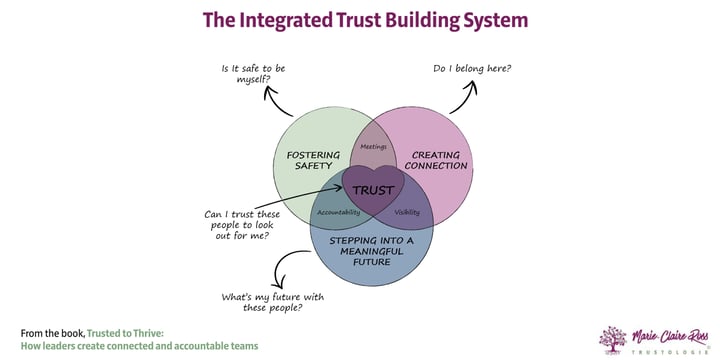
You do this through focusing on the three pillars that I highlight in the Integrated Trust Building System: fostering safety, creating connection and stepping into a meaningful future.
It's about running better one-on-ones or weekly check-ins to empower your reports to think through solutions themselves, improve their work and interact well with their colleagues. It also means working on accountability (improving delegation), improving visibility in the workplace, providing autonomy and excelling at communicating expectations and providing regular feedback.
ADPRI research found that workers who reported that they felt part of a team were not only 2.7 times as likely as others to be fully engaged, but also 3 times more likely to be highly resilient and twice as likely to report a strong sense of belonging to their organisation.
As Marcus Buckingham says, "Teams make a home for idiosyncrasy. In a team, each person’s unique loves and loathings can be combined with those of others to create something greater than any one person could achieve on their own."
Discover helpful tips to encourage your team members to feel part of a great team.
-1.jpg)
Learning when pull or push our people is key to achieving great results.

Find out the important leadership interactions that highlight a trusted leader.