





How Psychological Safety and Accountability are Inextricably Linked
Discover how psychological safety must be linked to accountability so that you get high performance.

Develop leaders, strengthen executive teams and gain deep insights with assessments designed to accelerate trust and performance.

Transform how your leaders think and perform with keynotes that spark connection, trust and high-performance cultures.

Explore practical tools, thought-leadership and resources to help you build trusted, high-performing teams.
Trustologie® is a leadership development consultancy founded by Marie-Claire Ross, specialising in helping executives and managers build high-trust, high-performing teams.

8 min read
You raise something small. A missed deadline. Turning up late again. A comment in a meeting that landed badly. You keep it private, calm and kind. Within a minute the conversation has flipped. Now it's about your tone, your timing and your motives. Then comes the line that ends it: "I don't feel safe right now."
If you back off, the standard quietly disappears, and the rest of your team notices. This article will help you tell genuine harm from ordinary discomfort, and show you how to hold accountability without abandoning the person.
Here's the short answer. When someone says they don't feel safe after feedback, start by finding out what felt unsafe. Check your own delivery and deal with any genuine issue. Then bring the conversation back to the observable behaviour, its impact and fair expectations. Psychological safety supports honest conversations. It was never meant to mean comfort, and it doesn't require you to give up on accountability.
Psychological safety is a shared belief that a team is safe for interpersonal risk-taking. That's the definition from Amy Edmondson's original research on work teams. It means you can ask the naive question, admit the mistake or challenge the boss without being humiliated or punished for it.
Weaponised psychological safety is something else. The words of safety are used to close down a conversation the person doesn't want to have. "I don't feel safe" stops being a request for help. It becomes an exit.
That is not a safety concern. That is avoidance dressed up as vulnerability. The phrase alone doesn't prove it. A pattern does.
The pattern tends to run the same way. A gentle reminder gets met with a list of reasons it's someone else's fault. Then comes a condition: "I'll change when you fix X." When that doesn't land, the focus moves to you. Suddenly you're the one being unreasonable, aggressive or untrustworthy.
Psychologists have a name for this: projection. It means attributing to someone else the very thing you're doing yourself. The person making the conversation unsafe, through excuses, false attacks and refusing to engage, accuses the leader of exactly that. You don't need to diagnose it to respond to it. But recognising it helps you stay steady when it happens.
I've been on the receiving end of this myself. I was told I couldn't be trusted to hold a safe space, by the person who was making the conversation unsafe. It's disorienting. And it's exactly why leaders need a way to tell discomfort from genuine harm.
It isn't always deliberate. Many people do it without realising, because being evaluated threatens how they see themselves. It isn't only a workplace thing, either. I see this in my own family. But whether or not it's deliberate, the effect on the team (and the leader) is the same.
Start with one question. Is this person expecting real punishment or feeling the normal discomfort of hearing they fell short?
|
Concerns that need investigation |
Reactions that may reflect feedback discomfort |
|---|---|
|
A pattern of retaliation for raising issues |
Embarrassment at being pulled up |
|
Public shaming or humiliation |
Disappointment or disagreement with the assessment |
|
Career damage after admitting mistakes |
Defensiveness that eases once the conversation is private and specific |
|
Others in the team describe the same fear |
Safety language that appears mostly when their own behaviour is being discussed |
These are prompts for inquiry, not a diagnostic test. Discomfort and a genuine concern can exist together. If you find a genuine safety issue, it needs addressing, starting with how you and others lead.
When a genuine need sits inside a deflection. Sometimes someone raises a real issue, such as a health need, a workload problem or a resource that was promised and never arrived. Then they make meeting expectations conditional on it being fixed. Handle the two things separately. Take the need seriously, act on what's yours to act on, and bring in HR where it involves a health condition or a reasonable adjustment. Then agree clear, reasonable expectations and a date to review them. The expectations may change to reflect the support needed. Accountability doesn't disappear.
A genuine need deserves a genuine response. It doesn't cancel accountability.
Most leaders replay the conversation and decide they were fine. But if the feedback was vague, late, public or delivered in frustration, part of the reaction is earned. Do a quick honest check. Was it private? Was it specific? Was it about behaviour, not character? Was it timely? When you can answer yes, you can hold the line without second-guessing yourself.
Under pressure, leaders tend to do one of two things. They apologise and retreat, or they dismiss the person ("Don't be ridiculous"). Retreating teaches that the tactic works, and dismissing seems to prove the person's point. Instead, get curious first: "I hear that this feels unsafe. What specifically are you concerned will happen? I want to understand that before we go on." If something genuine comes up, deal with it. If what you hear is discomfort, name the difference calmly. Feeling uncomfortable about feedback is normal. Feeling unsafe would mean expecting punishment or humiliation. This takes the heat out without taking accountability off the table.
When the accusations start, it's tempting to defend your motives and argue about who is really making it unsafe. That's a debate you won't win, and it's not the conversation you came to have. Name one concrete behaviour and its impact: "The last three client reports didn't follow the agreed structure, and the client asked for major rework." If they have concerns about you, offer to take those separately. Staying specific keeps the conversation about something that can be fixed.
Many people hear feedback as a verdict on whether you like or value them. If you don't address that fear directly, it drives the defensiveness. Say it out loud: "This conversation doesn't change how I see you. And we still need to sort out the client reports." Once someone knows the relationship isn't at risk, they have far less reason to fight for it.
Pushing through while someone is flooded doesn't work, and nor does dropping the topic forever. Agree a specific time to come back to it, such as "Let's pick this up at 10am tomorrow." Afterwards, write a short note of what you agreed. The pause gives the person space to settle, and the follow-up shows them the issue hasn't gone away.
If this becomes a pattern, keep brief, factual notes and involve HR early. Give the person a genuine chance to respond, and consider whether support or adjustments are needed. If someone makes a formal complaint, follow your organisation's process. The Fair Work Ombudsman is clear that reasonable management action carried out in a reasonable way is not bullying. How you do it matters as much as what you do.
|
When they say |
You might say |
|---|---|
|
"I don't feel safe right now." |
"I hear that this feels unsafe. What specifically are you concerned will happen? I want to understand that before we continue." |
|
"You're attacking me." |
"That's not my intent. I'm talking about the reports, not about who you are." |
|
"Everyone else does it too." |
"I'm happy to look at the wider team separately. Right now, this is about you and me." |
|
"I'll do it when you fix X." |
"Let's look at X and work out what support you need. Then we'll agree clear expectations and a date to review them." |
|
"You've never liked me." |
"I value you on this team. That's exactly why I'm raising this." |
If you'd like more on structuring these conversations, my guide to navigating difficult conversations walks through seven steps.
Across Australia, employers now have a legal duty to manage psychosocial hazards the same way they manage physical ones. Safe Work Australia's model Code of Practice: Managing psychosocial hazards at work
 Open
Opensets out what that looks like.
That cuts both ways. When someone says they don't feel safe, you have to take it seriously and check whether there's a genuine hazard. But the code also names conflict, poor workplace relationships and "poor organisational justice" as hazards. Poor organisational justice includes applying standards inconsistently. When one person's behaviour goes unaddressed because they used the language of safety, everyone else carries the risk.
Backing off doesn't make your workplace safer. It moves the hazard onto the rest of the team.
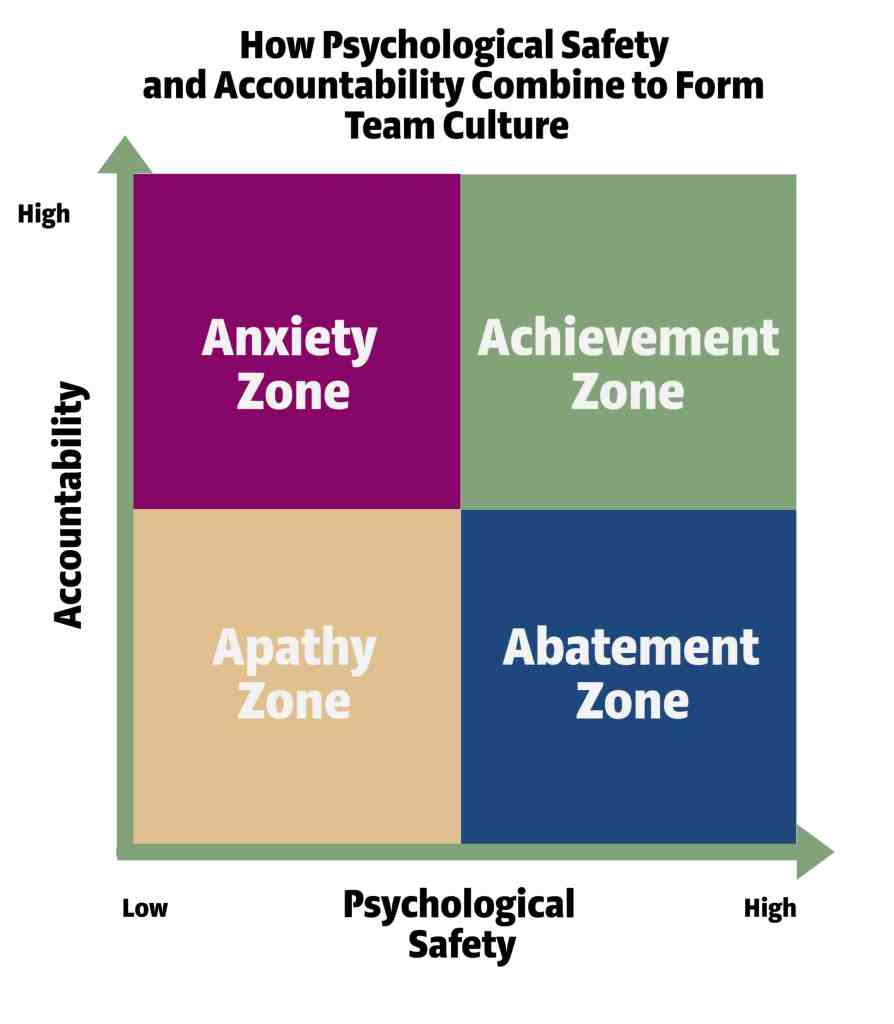
The Achievement Zone Model maps team performance against two things: psychological safety and accountability. When safety is high and accountability is low, a team sits in the Abatement Zone.
Each time a leader backs away because someone said they felt unsafe, safety stays high and accountability drops. It's the most deceptive zone, because it looks healthy. Engagement holds up and meetings are pleasant, while deadlines slide and your high performers grow quietly resentful.
The person who claimed to be unsafe pays too. They never get the feedback that would have helped them grow.
The goal is the Achievement Zone, where safety and accountability are both high. People take real risks, speak hard truths early and hold each other to a high standard.
Four things are feeding it.
When someone uses safety as a shield, backing off can feel like the kind thing to do. It isn't. It leaves your team carrying the cost, and it leaves the person without the feedback they need to grow.
One of the things I say in my book, Trusted to Thrive, is: "You can't talk your way into trust, you have to behave into it." Trust grows when your people see the same thing from you every time: a high standard, held calmly, by someone who clearly has their back.
That's what real safety looks like.
If your managers are avoiding the conversations that would lift performance, because they're worried about being told they've made someone feel unsafe, your business is paying for it. It shows up in missed targets and in frustrated high performers.
The Tribe of Trusted Leaders leadership development program is a 12-month program for CEOs who want their managers to build safety and accountability at the same time. Your leaders learn to have these conversations well, and to lead their teams into the Achievement Zone.
Find out how the Tribe of Trusted Leaders works
Discover how psychological safety must be linked to accountability so that you get high performance.

We often hear about the importance of psychological safety, but both physical safety and psychological safety are important to reduce interpersonal...

Learn how MAFS Australia 2025 showcases the importance of psychological safety and accountability in building successful workplace cultures.