





1 min read
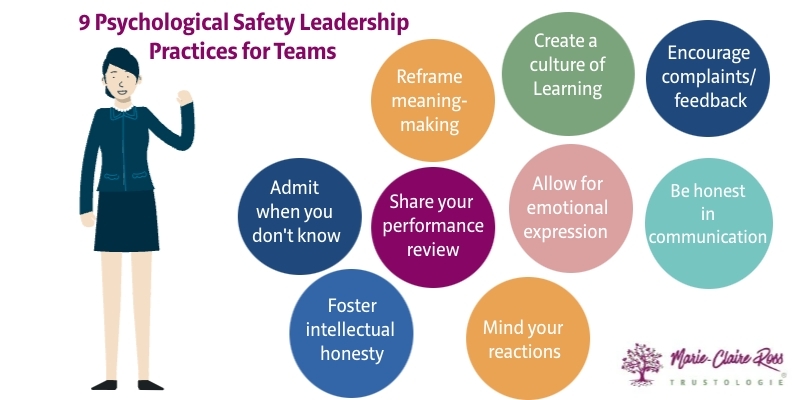
9 Helpful Ways to creating psychological safety in teams
Creating psychological safety in a team is critical for high performance. According to a Harvard Business Review article, studies show that...

Develop leaders, strengthen executive teams and gain deep insights with assessments designed to accelerate trust and performance.

Transform how your leaders think and perform with keynotes that spark connection, trust and high-performance cultures.

Explore practical tools, thought-leadership and resources to help you build trusted, high-performing teams.
Trustologie® is a leadership development consultancy founded by Marie-Claire Ross, specialising in helping executives and managers build high-trust, high-performing teams.

7 min read
Somewhere on your team right now, someone can see a problem, a risk, or a better way of doing something and they've decided it isn't worth mentioning.
Left long enough, that silence costs real money: wasted time, missed opportunities, and problems that only surface once they're already expensive to fix.
This article breaks down what a speak-up culture actually requires and the three steps that get your quietest employees telling you what they actually see.
A speak-up culture is a workplace where employees routinely share what they notice, not just when asked, and not just when something has gone wrong. It's broader than a complaints channel or an open-door policy. It includes flagging a client who's getting frustrated, mentioning a process that wastes an hour a week or raising an idea nobody asked for.
Psychological safety, the shared belief that it's safe to take an interpersonal risk in a team, is the condition most leadership advice points to when building this. It matters.
Fresh 2026 research from Wiley Workplace Intelligence found that employees who feel psychologically safe are 31% more likely to be high performers, which makes psychological safety a real performance lever, not a wellbeing extra sitting next to the P&L.
But treating psychological safety as the whole answer is where a lot of leadership advice goes wrong. Safety creates the conditions for voice.
It doesn't address whether an employee believes speaking up is worth the effort, or whether they're the kind of person who volunteers an observation unprompted in the first place.
Some people stay quiet even when the room is safe. They may be conflict-averse, naturally reserved, or simply unsure whether what they have noticed is important enough to say.
This gap matters commercially.
Usually leaders will listen the most to the person who is not afraid to speak out. The one with a lot to say (even if it's actually not worth saying). When we always listen to their voice, we are not harnessing the collective intelligence in the room.
Two different things are usually happening at once and leaders tend to only see one of them.
The first is leadership behaviour that quietly teaches people to stay quiet, often without the leader noticing.
Asking for feedback in front of a full room turns an open invitation into a public performance of career risk. A changed tone, an interrupted sentence, or a look away in response to a concern registers instantly as "don't bring me this again," long before the leader has consciously decided to react that way.
Keeping people in the dark about the reasoning behind a decision has the same effect: when people don't understand why something happened, they stop trusting they'll ever be told anything else either, and the silence starts running in both directions.
The second is simply how some employees are wired, independent of how safe the room actually is. Some people are naturally reserved, conflict averse, or unsure whether what they've noticed is significant enough to mention.
A speak-up culture doesn't build itself around these employees automatically, and treating their quietness as a personal failing on their part misses the actual lever available to a leader.
The technique that closes this gap is smaller than it sounds: ask what someone noticed, not what they think.
"What do you think?" asks a person to take a position and defend it, which is exactly the exposure a reserved or self-doubting employee is avoiding.
"What are you noticing, wondering about, or quietly working around that the rest of us may not be seeing?" asks for an observation instead. Noticing requires no confidence about whether it's significant.
If the first answer is thin, lower the bar further: "It doesn't need to be a strong opinion. What might be worth checking before we proceed?"
For higher-stakes topics, ask privately before a meeting so the person arrives with a thought already formed, rather than having to build one live in front of the room.
For a deeper look at the specific behaviours that create this pattern without leaders realising it, see 5 accidental ways leaders create a fear of speaking up in the workplace.
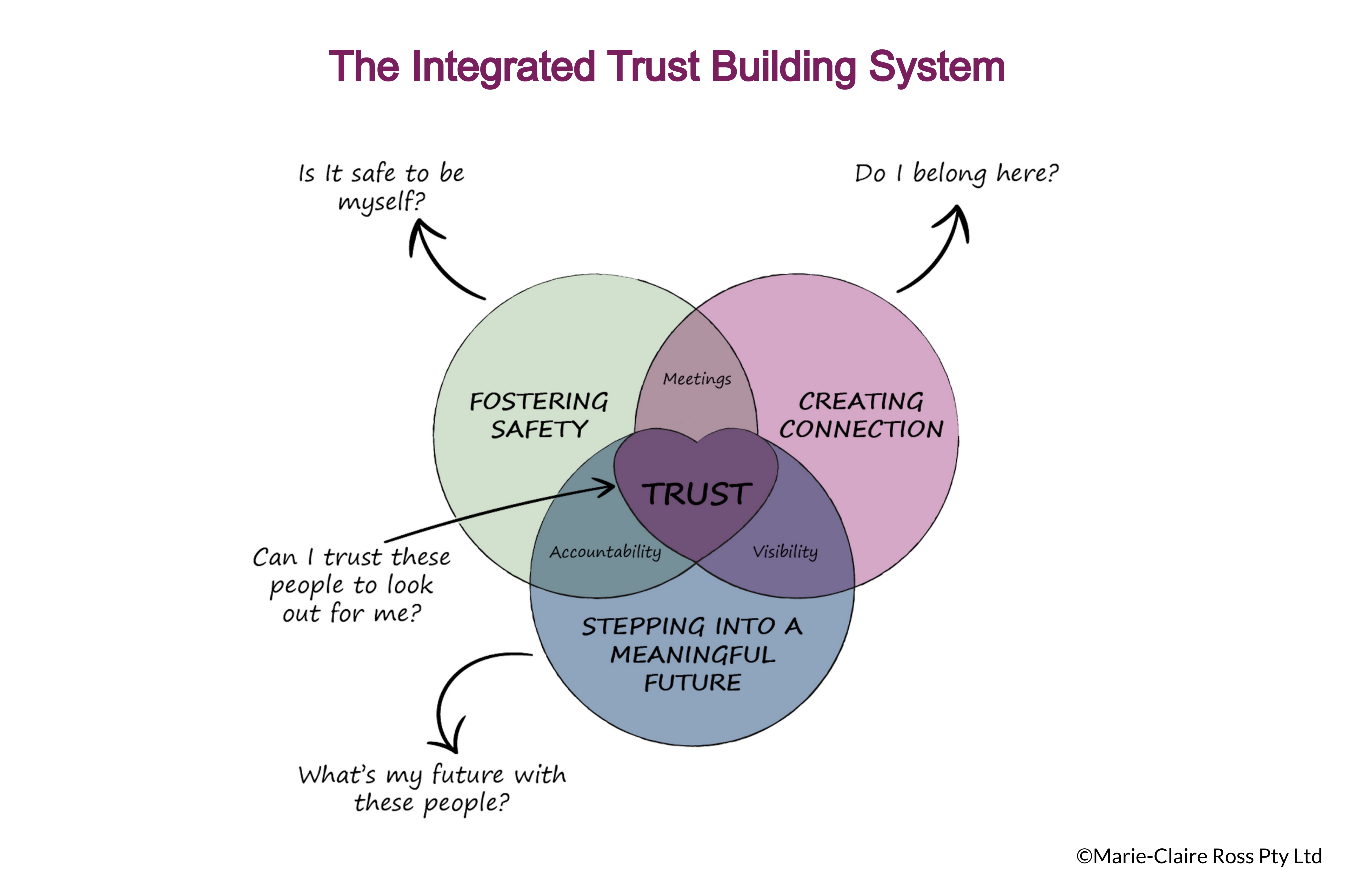
This is the core of what I call the Integrated Trust Building System (from the book, Trusted to Thrive, get a free chapter here), and it works best as three circles that overlap, not three steps you tick off in order.
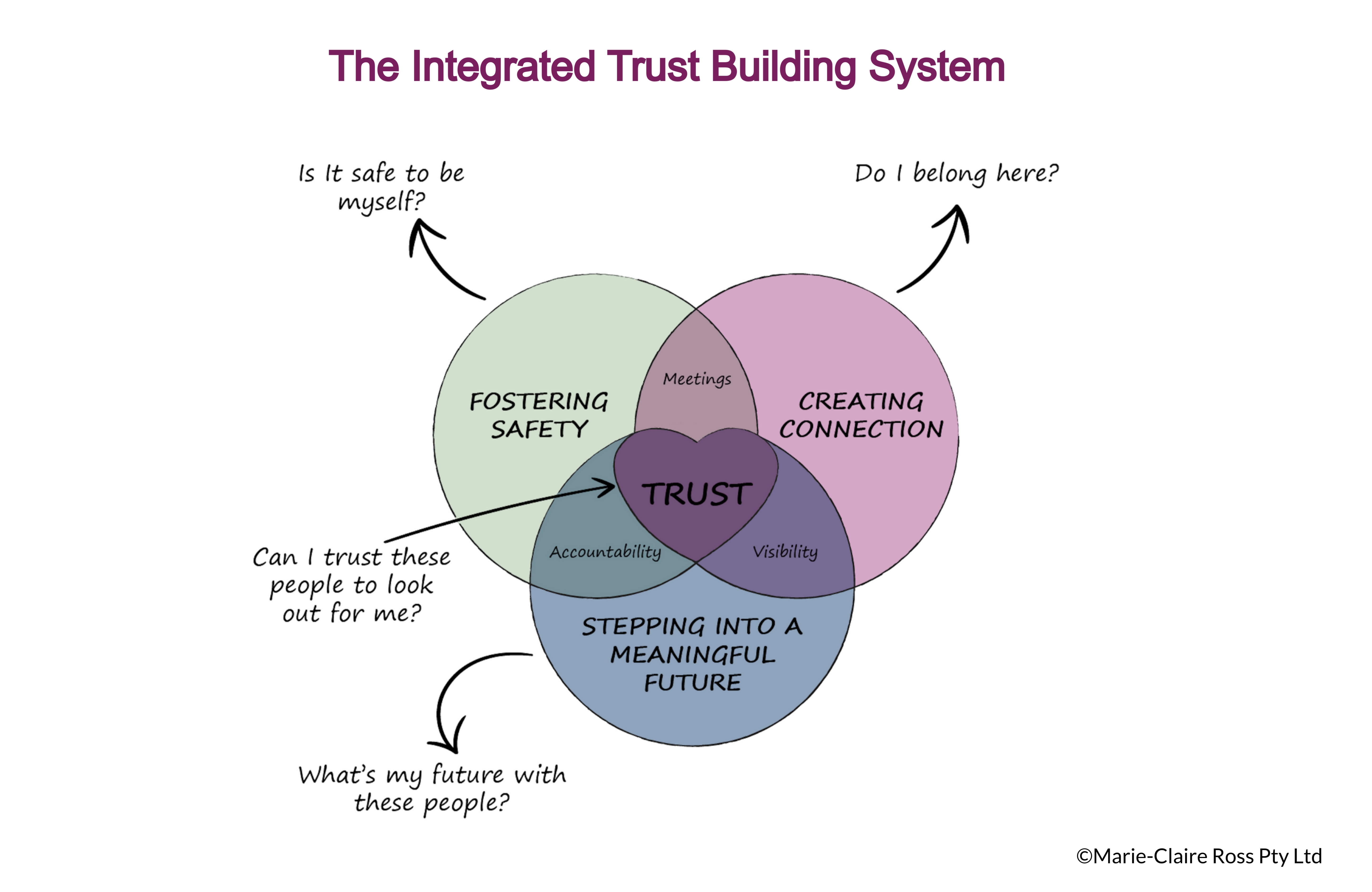
Safety is the step most leaders think of first and it does need active attention. It starts with noticing your own reactions as a leader: the changed tone, the interruption, the look away, all of which register as "don't bring me this again" whether you intend them to or not.
It also means asking questions that don't require confidence to answer. Replace "What do you think?" with "What are you noticing?" for anyone who tends to hold back, and give people a way to raise something without an audience watching them do it, whether that's a private conversation before a meeting or a written channel for topics people are least likely to raise unprompted.
Connection is the step that gets skipped the moment a business gets busy, and it's the one that turns a technically safe workplace into one people actually want to speak up in. It's built through something as simple as asking how someone's week has actually gone, because you actually want to know, then showing them specifically how their work connects to what others around them are doing.
This isn't a soft add-on to a speak-up culture. People share more when they see themselves as part of something, not just accountable for a task. A quiet employee who feels really connected to the people around them has a reason to bring you what they notice that a merely "safe" employee doesn't.
The third step answers the question a quiet employee is quietly asking themselves before they say anything: is this worth it? If someone can't see where the business is going, or how what they do this week moves it there, speaking up reads as extra effort with no real payoff.
Helping people see the destination, and their own part in reaching it, is what turns raising a concern from a risk into something worth doing. None of the three steps works in isolation. A safe, connected team with no shared direction still runs quiet, just politely. Building all three into how a leadership team operates, rather than leaving it to individual habit, is the kind of structural work covered inside the Tribe of Trusted Leaders program.
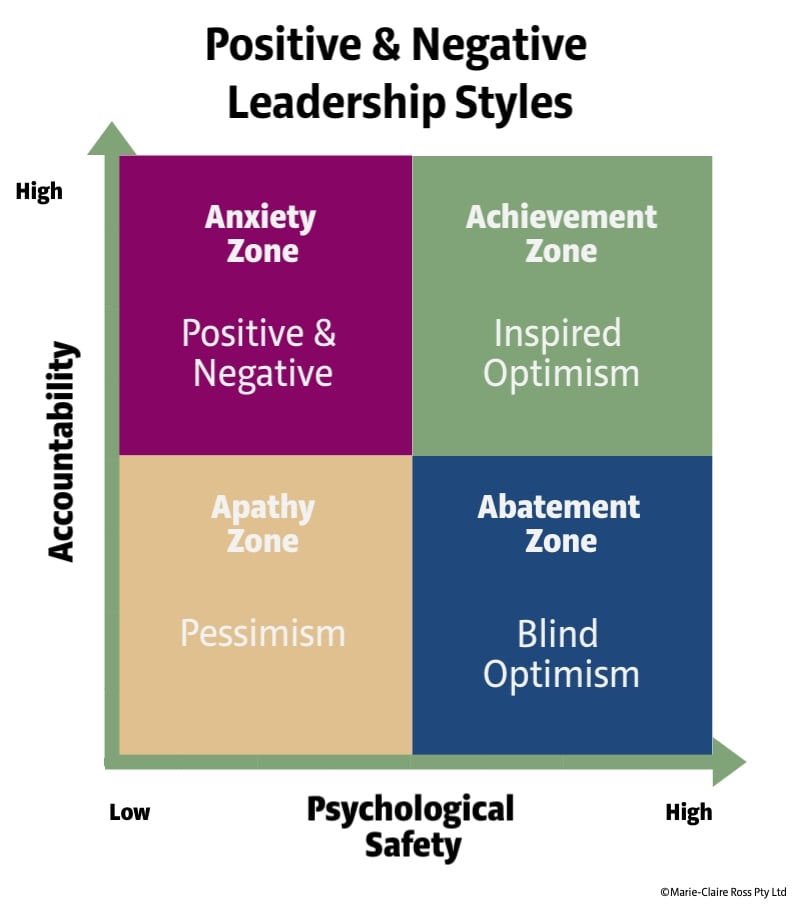
A missing speak-up culture is not a communication nicety. It can easily turn into an Abatement Zone team where people aren't talking about what is really important.
A common complaint I often have from leaders is "I stopped having one-to-one's because staff didn't have anything to talk about." That might be true, but in my experience, it's because no-one ignited their thinking by looking at things differently. As a leader you have to train the quiet ones (and the loud ones), to be more confident about what they might be observing, but dismissing without realising it. Our cognitive biases often stop us from seeing what's right in front of us.
Every unshared observation, unraised idea and unmentioned workaround is organisational knowledge that never reaches the person who could act on it. A quiet team isn't a calm one. It's operating on incomplete information, and so is everyone above it.
Use these in one-to-ones or team check-ins, particularly with people who tend to hold back:
Leaders rarely experience a missing speak-up culture as silence. They experience it as agreement, calm, or a lack of problems, right up until the moment it turns out to have been something else the whole time.
Building a team that actually tells you what it sees isn't about becoming a different kind of leader. It's about building safety, connection and a shared future deliberately for your quietest people, instead of assuming an open floor is doing that work on its own.
If you want to know where your own leadership team stands on this, book a conversation about executive coaching, or if the gap sits lower in your organisation, in the managers between you and your frontline, the Tribe of Trusted Leaders program is built specifically to close it at that layer.
1 min read
Creating psychological safety in a team is critical for high performance. According to a Harvard Business Review article, studies show that...

1 min read
“Organisations learn only through individuals who learn.” Peter Senge, MIT
1 min read
As I talk about in my book, Trusted to Thrive: How leaders create connected and accountable teams (get a free chapter here), research has...