









10 min read

Why Leaders of Leaders Need to Actually Hold Their Teams Accountable

Why Leaders of Leaders Need to Actually Hold Their Teams Accountable
12:40

Whether you're a CEO, GM, or senior leader managing other managers, here's what to hold your leaders accountable to (without micromanaging).

Emma was a natural.

She genuinely cared about her people. She had strong relationships, real business acumen, and the kind of warmth that made her team want to show up for her. But when she stepped into a leader of leader's role (responsible not just for her own team, but for managers who had their own teams) -something shifted. The skills that had made her a great leader of others weren't quite enough anymore.

The role required harder decisions. Firing people. Communicating a restructure. Holding her managers accountable for how they were leading, not just what they were delivering. And nobody had ever shown her how to do any of it.

"I had the relationships," she told me. "But I didn't have the confidence or the clarity."

What Emma experienced isn't unusual. In fifteen years of working with leaders, I've found it to be one of the most common and least talked about gaps in leadership development: leaders of leaders who were never taught what the role actually requires and who are now expected to hold others accountable for a standard nobody ever held them to.


The Leadership Accountability Pattern Nobody Talks About


Here is the uncomfortable truth most organisations quietly live with.

When leaders are promoted into roles where they manage other managers, they carry the habits of their previous role with them. They lead the way they were led. They hold people accountable for what they were always held accountable for - outputs, results and deliverables.

And many of them were never modelled anything different.

Their own leader didn't coach them. Didn't have consistent one-on-ones. Didn't give honest feedback early or hold difficult conversations before they became crises. Not because they were bad leaders, but because nobody had developed those skills in them either.

The pattern passes down quietly. And then we wonder why accountability is so hard to build.

Leadership accountability isn't just a role requirement. It's a practice that has to be taught, modelled and held.

The reason so many leaders of leaders struggle to hold their teams accountable isn't that they don't care. It's that they were never shown what it looks like and nobody is holding them to it now.


Three Expressions - and Why Leaders of Leaders Get Stuck in All of Them


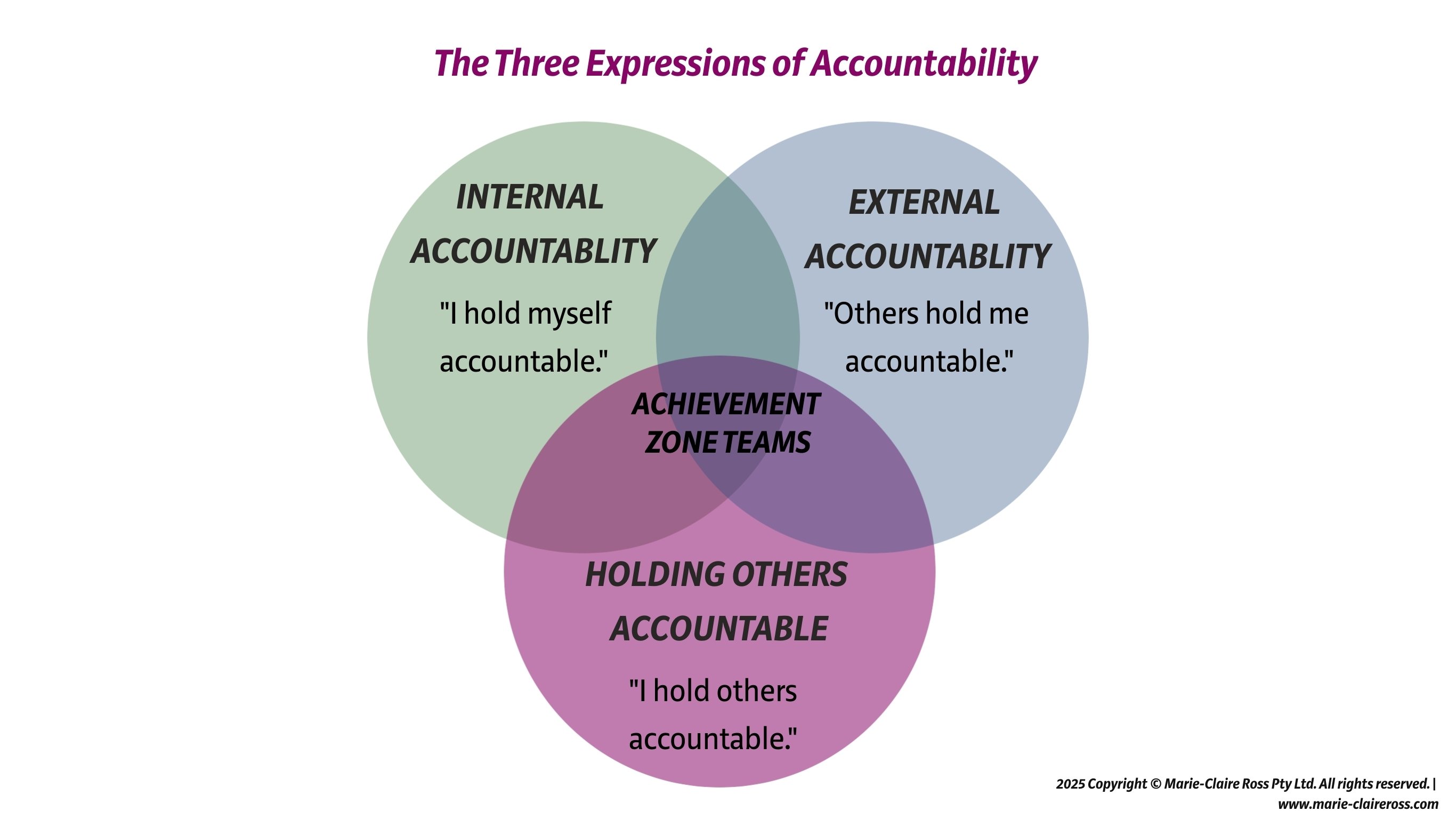
In my work with leaders and teams, I've found that accountability operates across three distinct expressions. Leaders of leaders tend to get stuck in all three without realising it.

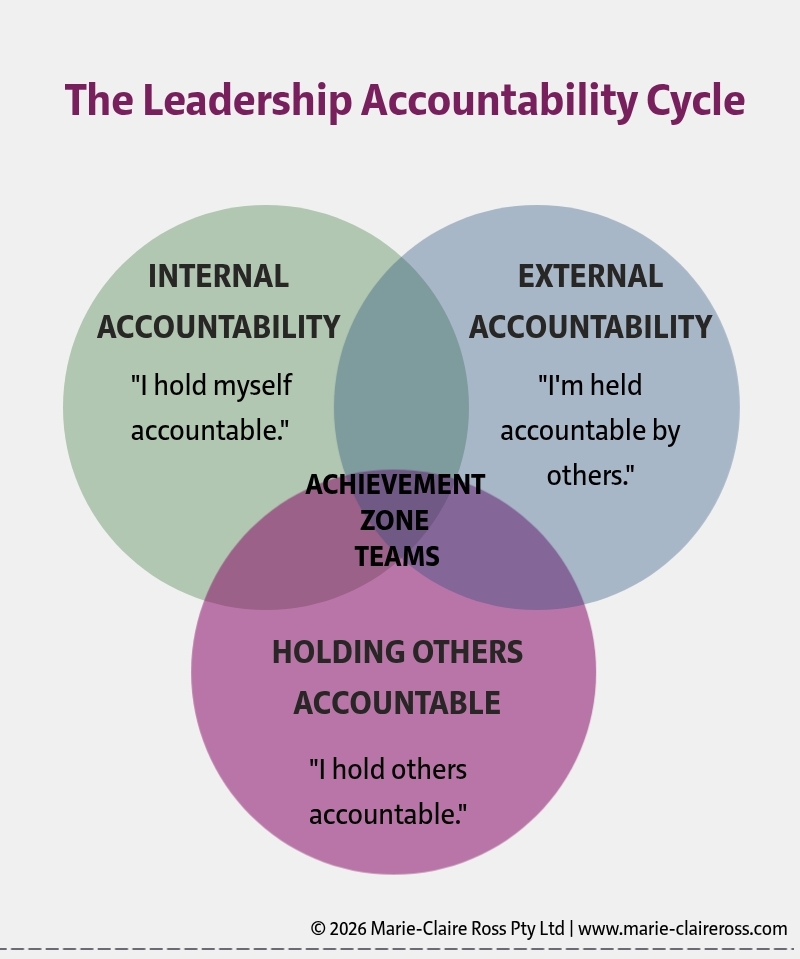
The Leadership Accountability Cycle by Marie-Claire Ross — a three-circle Venn diagram showing the three expressions of leadership accountability: I hold myself accountable, I am held accountable by others, and I hold others accountable, converging to create Achievement Zone Teams.


Expression 1: Internal Accountability - "I hold myself accountable"


This is where the work begins. And for leaders of leaders, it's also where the hardest question lives.

Am I actually holding myself accountable as a leader or am I still measuring my value by what I personally produce?

This kind of internal accountability requires genuine self-awareness - an honest reckoning with where you're actually spending your leadership energy.

Most leaders who move into leader of leaders roles don't consciously answer this question. They stay busy. They keep delivering. They remain close to the technical work because it's familiar, because they're good at it, and because it feels more measurable than the slower, less visible work of developing other leaders.

But this is the shift the role demands. Your value is no longer in what you produce. It's in what your leaders produce and in the quality of leadership they're providing to their own teams.

Internal accountability at this level means honestly asking:

  • Am I investing in my own leadership development?

  • Am I modelling the behaviours I want to see in my managers?

  • Am I clear on what I actually value or am I still rewarding myself and others for doing, when I should be rewarding for leading?

This is the expression most leaders find hardest to admit they're missing. Because it requires looking at yourself before looking at others.

Reflection question:

"Am I measuring my value as a leader by what I personally produce or by how well my leaders are developing?"


Expression 2: Being Held Accountable - "I'm held accountable by my leader"


Here's the part that tends to land more comfortably because it shifts the gaze upward rather than inward.

Most leaders of leaders were never held accountable for the quality of their leadership. They were held accountable for results. And results are important. But results without attention to the leadership behaviours that create them is like trimming the top of a tree without tending the roots.

If nobody has ever asked you: How often are you developing your managers? What does your coaching look like? How are you handling underperformance in your team?  Then, you have been held accountable for the wrong things.

This matters not just for your own growth, but for the pattern you then replicate.

When leaders are only ever held accountable for outputs, they hold their own people accountable for outputs. The cycle continues. The leadership work - the coaching, the feedback, the development, the difficult conversations - stays invisible and undervalued at every level.

Research by the American Society for Training and Development shows that having scheduled accountability check-ins with a partner boosts your chances of achieving a goal to 95%, compared to 50% when you have a plan but no one to answer to. The same principle applies to leadership development. Without someone holding you to it, the important work keeps getting displaced by the urgent.

Reflection question:

"Have I created regular space to align with my own leader on leadership behaviours, not just results?"


Expression 3: Holding Others Accountable - "I hold my leaders accountable"


This is where it becomes cultural.

Once a leader of leaders has done both the:

  1. Internal work - honestly examining their own accountability as a leader, and

  2. External work - is being appropriately held accountable by those above them.

Holding their own managers accountable becomes a natural extension rather than a forced exercise.

But without the first two expressions in place, this third one tends to look like one of two things:

  • micromanagement (watching everything because trust hasn't been built), or

  • abdication (hoping for the best because the conversations feel too hard).

Emma knew this pattern well. She had the relationships. She had the care. But when it came to holding her managers to a standard, giving difficult feedback, addressing underperformance, communicating a restructure with clarity, she didn't yet have the tools or the confidence.

"The role required making harder decisions," she told me. "And I had to learn to do that without apologising for it."

What she needed wasn't toughness. She had plenty of that underneath. What she needed was clarity about what to hold her leaders accountable for and how to do it in a way that was still her.

Reflection question:

"Am I holding my managers accountable for how they're leading or only for what they're delivering?"


When all three expressions are working together, you create the conditions for what I call an Achievement Zone team. It's where psychological safety and high accountability coexist, and where performance becomes sustainable rather than exhausting. People stretch without snapping. They lead with clarity and they grow together.


What to Actually Hold Your Leaders Accountable For 


If you're a leader of leaders, these are the conversations worth having with your managers - not instead of the results conversations, but alongside them.

The quality of their hiring decisions. Are they building a team that raises the bar or filling vacancies fast? A pattern of poor hiring quietly undermines everything else.

The frequency and honesty of their feedback. Are they having real one-on-ones or performative check-ins? Are they addressing underperformance early or waiting until it becomes a crisis?

Their coaching activity. Not formal coaching sessions necessarily, but the daily habit of developing people. Are they asking questions before providing answers? Do they know what each person on their team needs to grow?

How they communicate hard things. Restructures. Performance issues. Difficult decisions. These don't get easier with avoidance. A leader of leaders who can't communicate hard things clearly and with care is a liability. Not because they're unkind, but because their team is operating without the clarity they need.

Results through the team, not just by them. The question isn't what they personally achieved. It's what their team achieved and what role they played in creating the conditions for it.

How well they translate strategy into meaning for their team. It's not enough for your managers to know the plan. Their job is to help their people understand how their daily work connects to the bigger picture - especially when things change. A restructure, a pivot, a new direction needs to be customised for individual teams. Leaders of leaders who can't do this leave their teams anxious and rudderless. And when strategy shifts, as it always does, a manager who hasn't developed this skill will either over-explain in ways that create panic, or under-communicate in ways that create rumour. Neither is neutral. Both cost you.


Why Holding Leaders Accountable for Leadership Work Is Hard and Why It's Worth It


Holding leaders accountable for leadership work is uncomfortable precisely because it asks you to make visible the things that have always been invisible.

It's much easier to look at a sales figure than to assess the quality of a feedback conversation. It's much easier to track output than to evaluate whether your managers are genuinely developing their people.

But Emma's story doesn't end with the struggle.

Her CEO made a decision that changed everything, not just for Emma, but for her entire leadership team. He put them all through the Tribe of Trusted Leaders program together.

What happened next is something individual coaching rarely produces.

Because Emma and her managers were learning the same frameworks at the same time, the content didn't stay in the training room. It moved into their daily work almost immediately. They'd have conversations about what they were learning - unpacking it, debating it, then applying it. From team meetings to one-on-ones, the language became shared. The frameworks became shorthand. And the hard conversations, the ones about accountability, performance, and leadership expectations,  became easier not because they were less difficult, but because everyone in the room already knew the vocabulary for having them.

Holding her managers accountable stopped feeling like a confrontation. It felt like a continuation of a conversation they were already having together.

That's the difference between developing one leader and developing a leadership team. One person returns from a program changed, and struggles to shift a culture that hasn't moved with them. A team returns with the same language, the same tools, and the same commitment and the culture shifts because the people inside it have shifted together.

95% of Tribe graduates are considered promotion-ready by their organisation by the end of the program. Not because they worked harder. Because they finally understood what their job actually was and had the tools, the practice, and the accountability to do it well.


The Leadership Accountability Question Worth Sitting With


If your leaders were asked today: What are you being held accountable for as a leader?  What would they say?

If the answer is mostly about results, that's a signal. Not that results don't matter. But that the leadership work underneath them has been left to chance.

And leadership work left to chance gets passed down - just as it was inherited by the leaders in your organisation now.

The cycle ends when someone decides to hold themselves to a different standard first.

That's where accountability always begins.


If you have leaders of leaders in your organisation who are ready to make this shift, the Tribe of Trusted Leaders program is designed for exactly this transition - from managing outcomes to genuinely leading leaders.

Book a conversation with Marie-Claire →


Marie-Claire Ross is the founder of Trustologie® and author of Trusted to Thrive. She works with CEOs, GMs, and senior leaders to build high-trust, high-performing leadership teams across Australia and internationally.


Frequently Asked Questions

Leadership Accountability: The Three Expressions That Build High-Trust, High-Performing Teams

3 min read

Leadership Accountability: The Three Expressions That Build High-Trust, High-Performing Teams

When most people hear the term leadership accountability, they often picture a manager holding others to account - calling out missed deadlines,...

Read More
Leadership Expectations Have Evolved: 6 Key Leadership Beliefs to Unlearn

Leadership Expectations Have Evolved: 6 Key Leadership Beliefs to Unlearn

Leadership feels heavier now. Not just because leaders are carrying more, but because what people need from leadership has changed.

Read More
8 Powerful Ways for Team Leaders to Create a Culture of Accountability

8 Powerful Ways for Team Leaders to Create a Culture of Accountability

Did you know that one out of every two managers is terrible at accountability? According to a study published in Harvard Business Review that...

Read More