


7 Trust Behaviours of Effective Leaders
One of the most common complaints from employees revolves around whether they believe their organisation can be trusted.
Develop leaders, strengthen executive teams and gain deep insights with assessments designed to accelerate trust and performance.

Transform how your leaders think and perform with keynotes that spark connection, trust and high-performance cultures.

Explore practical tools, thought-leadership and resources to help you build trusted, high-performing teams.

Trustologie® is a leadership development consultancy founded by Marie-Claire Ross, specialising in helping executives and managers build high-trust, high-performing teams.

7 min read
Marie-Claire Ross : April 21, 2026
Table of Contents
How Burnout looks different across an organisation
Early-career employees: burnout as confusion and insecurity
Mid-level managers: burnout as responsibility without authority
Senior leaders and executives: burnout as moral fatigue and isolation
Early in my career as a market research consultant, I was given deadlines that made little sense. A client from a large company wanted a final report by Friday, which meant my boss expected a draft by Wednesday.
I questioned why the timeline was so tight and whether the client even needed the report that quickly. In my previous role, I would have been able to talk directly with clients, clarify what they needed, and negotiate realistic deadlines. But with this boss, those conversations were shut down. He kept clients close to him, agreed to whatever they wanted, and expected the team to absorb the pressure.
What made it worse was that I was regularly criticised, often without clear guidance on what “good enough” actually looked like. I never felt sure how to succeed, and that constant criticism created a sense of pressure that went beyond workload alone.
It was that combination of unrealistic demands, limited control, and ongoing criticism that contributed to my burnout. That experience taught me that burnout is rarely about hours alone - it’s often about power, control, and the conditions people are expected to work in.
That was 26 years ago. It was my last full time job working for someone else.
Burnout at work is not just about long hours. It’s what happens when the demands of the role consistently exceed the clarity, control, and support people have to do their job well.
Another way to look at it is:
Burnout is what happens when effort keeps rising but agency, clarity, and support don’t rise with it.
This is where many leaders get it wrong. They look at workload. But burnout is far more often a problem of structure, expectations, and how pressure is managed.
Burnout doesn’t always look like breakdown, either. Often, it looks like competence. The person who keeps delivering, keeps saying “I’ll handle it,” and quietly absorbs more than is sustainable.
That’s why burnout is often missed. You’re not seeing capacity. You’re seeing coping.
Burnout does not look the same at every level. It shows up differently depending on where someone sits on the org chart, how much authority they have, and how much unresolved pressure they are expected to carry.
There is also a leadership effect here. Leaders shape culture not only by what they say, but by what they model. If a leader normalises overwork, constant availability, emotional suppression, and blurred boundaries, the team learns that this is what commitment looks like. If a leader models clarity, realistic pacing, boundaries, and honest conversations about pressure, the team is more likely to work sustainably.
That is one reason burnout management starts at the top. It matters because Gallup research also finds that managers influence about 70% of team engagement and wellbeing -when leaders burn out, they don’t fall alone; their teams follow.
For early-career employees, burnout often looks like constantly guessing what “good” looks like, decoding expectations, worrying about being replaced, and feeling ashamed for not keeping up. At this stage, burnout is often driven by low clarity and low control.
It can be easy to miss because it may not look like exhaustion at first. It can look more like disorientation, anxiety, and overcompensating.
For mid-level managers, burnout often stems from rising responsibility without matching authority. They’re expected to translate strategy, absorb pressure, steady teams, and deliver results—yet decision rights are vague and resources thin. They sit in the middle of competing demands: senior leaders pushing for outcomes and teams needing clarity, protection, and support. Many work longer hours not because they are ineffective, but because they are trying to regain control in systems that do not support focus, clarity, or capacity.
This is where burnout management strategies need to address structure, not just stamina.
At the executive level, burnout often shows up as moral fatigue. When leaders are repeatedly pushed to make decisions that clash with their values, the issue shifts from stress management to protecting their sense of integrity. Research backs this up: ongoing role conflict and misalignment between personal values and organisational demands are strongly linked to higher stress, lower engagement, and greater risk of emotional exhaustion and cynicism.
Sometimes executive burnout shows up in a more disguised way. A leader tells themselves they are protecting the team from overload, so they keep holding work, delaying delegation, or doing tasks that should sit elsewhere. On the surface, it can look caring.
In practice, it often creates the opposite outcome: the team is capable, the work could be shared, but the leader is the one becoming panicked, overloaded, and exhausted. This is one of the more subtle ways burnout shows up at senior levels - not just through pressure from above, but through the habit of carrying too much below
And when senior leaders burn out, it does not stay contained. Their tone, pace, reactivity, and decision-making ripple through the business. Teams often end up absorbing what leaders do not name or manage well.
Burnout in leaders is not a private issue. It shapes how decisions are made, how pressure moves, and what people believe is required to succeed.
A self-aware leader under pressure may still protect their team. An unaware leader under pressure almost always passes it on - through urgency, inconsistency, reactivity, or silence.
Leadership doesn’t just experience burnout. It distributes it.
That’s why this matters.
If you want a healthy, accountable, high-performing team, you don’t start with wellbeing initiatives.
You start with how leadership handles pressure.
Burnout isn’t solved by pushing harder or becoming more resilient. For senior leaders, it’s solved by reducing unnecessary strain, clarifying decision-making, and redesigning how pressure is carried.
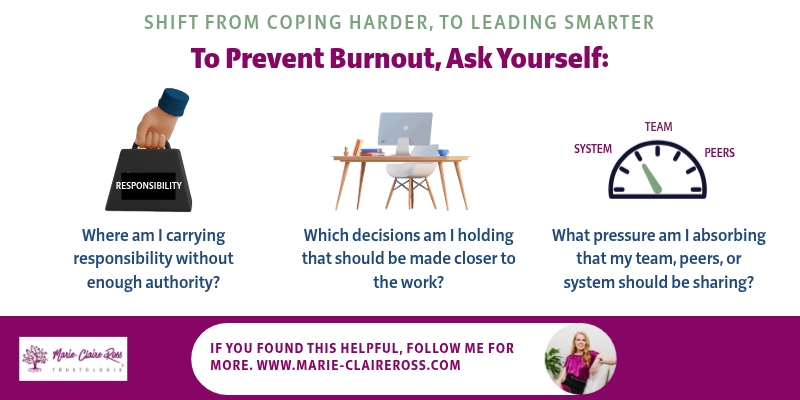
Before jumping into solutions, start here:
Where am I carrying responsibility without enough authority?
Which decisions am I holding that should be made closer to the work?
What pressure am I absorbing that my team, peers, or system should be sharing?
These questions shift the focus from coping harder to leading differently.
From there, the following seven burnout management strategies can help you act.
Burnout often grows when leaders are responsible for outcomes but unclear about what they actually control. If you are holding too many decisions, or making decisions that should sit closer to the team, burnout management starts by defining who decides, who advises, and who executes.
This directly answers the question: Which decisions do I need to stop holding and delegate?
With my executive coaching clients - especially CEOs - this is often where a hidden block shows up. On paper, they can make big decisions, but in practice they hand their power to others: the board, investors, customers, or “the market.”
They’ve internalised the idea that someone else must have the final say, so they defer instead of deciding. That creates frustration for them and for those around them. Over time, the constant second-guessing erodes confidence and becomes its own path to burnout.
Managers in particular are vulnerable to burnout when they are expected to deliver results without the authority to set priorities, timelines, or resources. A key burnout management strategy is to surface where responsibility and authority are out of alignment and address it directly. This helps you stop answering the first question by force of will and start redesigning it deliberately.
When everything is treated as urgent, burnout becomes a constant background condition. One of the most effective burnout management strategies is to narrow the focus to the few priorities that matter most and let the rest wait, pause, or stop.
This reduces the pressure of carrying too much and begins to ease the strain described in the third question: What pressure should I be sharing or letting go?
Availability is not the same as effectiveness. If you are always reachable, always responding, and always absorbing other people’s urgency, burnout will build quickly.
Strong burnout management means setting clear expectations about response times, after-hours communication, and what truly requires immediate attention. This helps you protect your time and energy instead of absorbing pressure that should be distributed more realistically.
It also means modelling those boundaries yourself. If you tell your team to switch off but keep emailing late at night, they will follow your behaviour more than your words.
Part of my own burnout came from being criticised without clear guidance. That is common. People burn out faster when they are told they are not doing enough but are never given clear direction on what to change.
A healthier burnout management strategy is specific, timely feedback that helps people improve rather than leaving them guessing. Good leaders reduce unnecessary anxiety by making expectations visible and feedback actionable.
Executives and CEOs often carry burnout quietly because there are few places where they can be fully candid. Burnout management at senior levels requires trusted peer support, executive coaching, or confidential conversations where pressure, uncertainty, and moral strain can be spoken out loud. When leaders have somewhere to think before they act, the questions about responsibility, decision‑making, and pressure can be discussed openly, not just carried internally.
Burnout management only works when the response matches the cause.
If the issue is overload, reduce the load.
If the issue is low control, increase autonomy.
If the issue is role ambiguity, unclear expectations, or a leadership style that no longer fits, the solution may be coaching, role redesign, or a shift in how the work is structured.
Not all burnout needs the same answer. The quality of the diagnosis matters.
Most leaders already know the basics: they need clearer boundaries, time off, better self-care, sharper priorities, and more delegation.
But when burnout keeps coming back, it’s no longer a time management problem. It’s a leadership pattern. It's become part of your leadership identity.
If you’ve tried time blocking, leave, firmer boundaries, self-care, or “being more disciplined” and the same overload keeps returning, the issue is probably not your calendar. It’s more likely the way you’re holding responsibility, how pressure flows through your role, and the habits you’ve developed for leading under stress.
This is especially true for capable leaders. High performers often cope for a long time by becoming more responsible, more available, and more self-reliant. From the outside, that can look like strength. On the inside, it can become unsustainable.
That is when burnout stops being just a wellbeing issue and becomes a leadership issue.
This is also where executive coaching becomes valuable. Not as a quick fix or another performance tool, but as a structured way to examine what you are carrying that no longer belongs with you, where you may have confused control with leadership, how your leadership habits under pressure are shaping your team, and what needs to change for you to lead sustainably at your level.
Not as another performance tool or a quick fix. But as a structured way to examine:
What you are carrying that no longer belongs with you?
Where you’ve confused control with leadership?
How your habits under pressure are shaping your team?
What needs to change for you to lead sustainably at your level?
Because at senior levels, burnout isn’t just about doing too much. It’s about leading in a way that is no longer sustainable.
The management of burnout is most effective when it is treated as a leadership and systems issue, not just an individual one. That means looking at how work is assigned, how decisions are made, how feedback is given, and how much emotional and practical pressure one person is expected to carry.
For managers, executives, and CEOs, burnout management is about creating conditions where people can do good work without constant overextension. When leadership roles become heavier, the answer is not always more effort. Often, it is better clarity, better boundaries, better delegation, and better design.
Managers who regularly practice self‑care, talk about it, and set boundaries are more likely to stay resilient and see stronger team performance.
Leaders set the tone. If you model overwork, your team will read that as the standard. If you model clarity, boundaries, self-awareness, and realistic expectations, you create a culture that is more sustainable for everyone.
If burnout is becoming a pattern, not just a busy period, then working harder won’t solve it.
Something in how the role is being led needs to change.
If you’re ready to stop carrying pressure in ways that are no longer sustainable, book a conversation with me about executive coaching.
One of the most common complaints from employees revolves around whether they believe their organisation can be trusted.
It can be a game-changer for leaders to look at how much psychological safety and accountability they create in their teams.